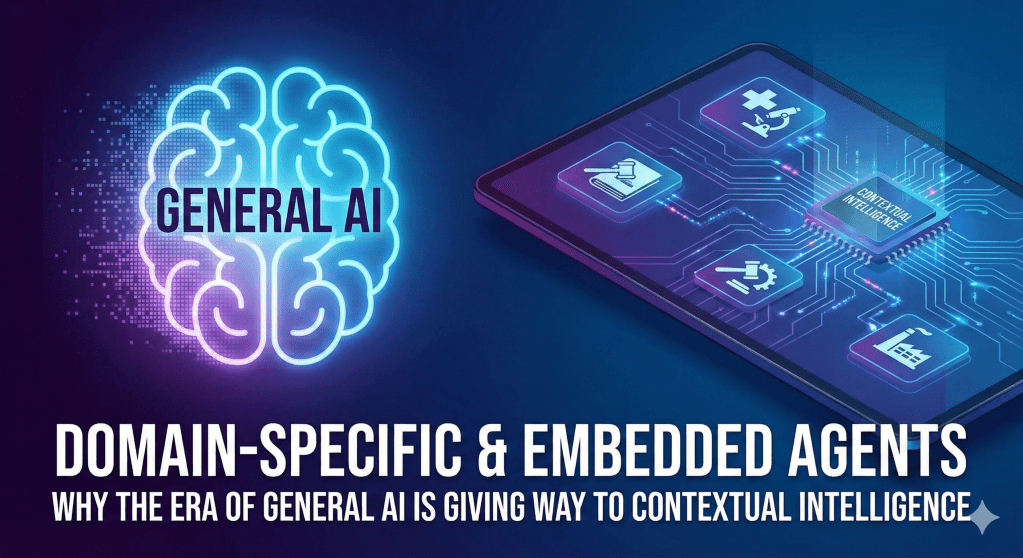
For the past few years, AI innovation has been dominated by a race toward ever-larger, general-purpose language models. Bigger models, broader knowledge, more parameters. But quietly and decisively that narrative is shifting.
The future of AI is not one-size-fits-all. It is domain-specific, embedded, and deeply contextual.
We are entering the era of Domain-Specific & Embedded Agents.
From Standalone Chatbots to Embedded Intelligence
Early generative AI adoption centered on standalone chat interfaces—general assistants capable of answering almost anything, reasonably well. While powerful, these systems struggle when deployed inside real operational environments:
- They lack deep understanding of domain-specific jargon
- They don’t respect industry constraints, regulations, or workflows
- They operate outside the systems where decisions actually happen
Enter embedded agents.
Instead of existing as a separate conversational layer, these agents live inside products, platforms, and operational technology manufacturing equipment, legal research tools, financial risk systems, healthcare workflows, and supply chain platforms.
AI is no longer something you talk to. It’s something that acts within the system itself.
The Rise of Small Language Models (SLMs)
At the heart of this shift is the growing adoption of Small Language Models (SLMs).
Unlike massive general-purpose models, SLMs are:
- Trained or fine-tuned on proprietary, vertical-specific data
- Optimized for narrow, high-value tasks
- Cheaper to run, easier to govern, and faster to deploy
- Easier to embed directly into products and edge systems
In many enterprise settings, SLMs outperform large models not because they “know more,” but because they know exactly what matters.
This is especially critical in regulated and mission-critical industries, where precision, auditability, and predictability matter more than broad reasoning ability.
The Shift: From General Reasoning to Contextual Intelligence
What’s really changing is not just model size—it’s how intelligence is defined.
We are moving from:
“Can the model answer anything?”
to:
“Can the agent understand this domain, this workflow, this constraint?”
This is contextual intelligence.
A domain-specific agent understands:
- Industry terminology and edge cases
- Regulatory boundaries and compliance rules
- Operational constraints and real-world trade-offs
- The difference between what is theoretically correct and what is operationally acceptable
For example:
- In FinTech, agents must reason within risk limits, capital rules, and audit trails
- In Healthcare, agents must respect clinical protocols, data sensitivity, and safety thresholds
- In Law, agents must understand precedent, jurisdictional nuance, and liability
General intelligence is impressive. Contextual intelligence is deployable.
Why Embedded, Domain-Specific Agents Win
This new generation of agents succeeds because they are:
1. Closer to the Data
They operate directly on proprietary, real-time, and structured enterprise data—not just public text.
2. Aligned with Workflows
They assist, automate, or decide within existing systems, instead of asking users to switch tools.
3. Easier to Govern
Smaller, purpose-built agents are easier to test, validate, monitor, and regulate especially critical for enterprise and regulated environments.
4. Built for Scale, Not Spectacle
They optimize for reliability, cost efficiency, and sustained value creation not demo-driven wow factors.
What This Means for AI Builders and Leaders
The next wave of AI differentiation will not come from having the “best” general model.
It will come from:
- Owning deep domain data
- Designing agents around specific decision points
- Embedding intelligence into core systems
- Treating governance, safety, and constraints as design inputs not afterthoughts
In short, the winners will be those who move from AI as a feature to AI as infrastructure.
The age of broad, generic AI is not ending but it is no longer the center of gravity.
The real transformation is happening quietly, inside systems, products, and workflows powered by domain-specific, embedded agents that don’t just generate text, but understand context and take action.
The future of AI isn’t louder. It’s smarter, smaller, and deeply embedded.
 AI Academy
Leave a comment