Balancing Central IT Control with Agile Team Autonomy Using Google Cloud’s Folder & Project Hierarchy
For most enterprises, the biggest challenge in cloud adoption is not technology. It’s governance versus agility.
Central IT wants consistency, security, and control. Product and engineering teams want speed, autonomy, and freedom.
The tension is real: Too much centralisation → innovation slows down. Too much autonomy → risk explodes.
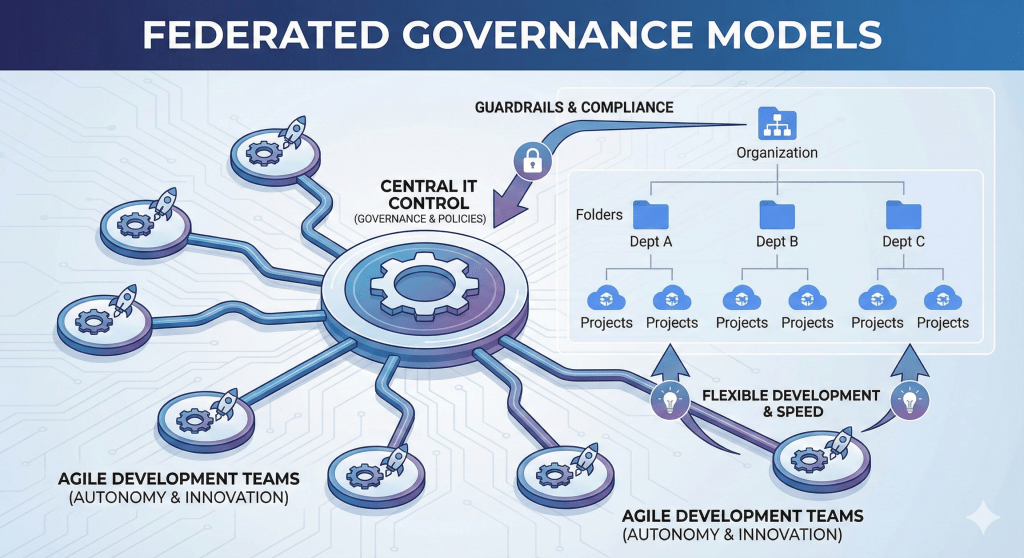
The solution is not choosing one side. The solution is Federated Governance a model where central IT sets the guardrails while product teams innovate inside a pre-approved, secure environment.
Google Cloud’s folder → project → resource hierarchy is one of the cleanest architectures to implement this at scale.
In this article, we’ll break down how federated governance works, how Google Cloud enables it, and what modern enterprises must put in place.
1️⃣ Why Centralised Governance Fails (Alone)
Traditional top-down governance models collapse because:
- Every request becomes a ticket
- Delays frustrate engineering teams
- Central IT becomes a bottleneck
- Shadow IT emerges to “move fast”
- Governance is perceived as slowing innovation
This model cannot survive the speed requirements of modern AI development, digital channels, or product-led growth.
Cloud-native teams need room to experiment, deploy, and iterate rapidly.
But that autonomy must live inside safety boundaries.
2️⃣ Why Fully Decentralised Governance Fails (Alone)
The opposite extreme—letting every team configure cloud however they want creates chaos:
- Inconsistent IAM roles
- Multiple VPC patterns
- Fragmented logging
- Non-standard encryption
- Duplicate services
- Cost overruns
- No unified audit trail
- Unclear ownership
This is how multi-cloud becomes multi-chaos.
The organisation loses control of risk.
Enter Federated Governance.
3️⃣ Federated Governance: The Best of Both Worlds
Federated governance means:
Central IT defines guardrails Teams get self-service autonomy within those guardrails
This creates a system where:
- Security is standardised
- Costs are visible
- Identity is enforced
- Compliance is automatic
- Teams can deploy fast without asking permission
The beauty? Developers move quickly because governance already exists, not in spite of it.
4️⃣ How Google Cloud Enables Federated Governance
Google Cloud’s organizational structure is built for federated models.
Organizational Levels:
- Organization Node – The root of trust – Central IT owns this – Defines global policies, IAM boundaries, and org-level constraints
- Folders (Business or Domain Aligned) – Line of Business / Product / Region – Delegated governance – Policy inheritance – Team-level autonomy
- Projects (Application / Workload Aligned) – Where engineering teams deploy resources – Autonomous execution zones – Enforce guardrails through policy inheritance
- Resources (Compute, Storage, Kubernetes, etc.) – Created and destroyed by teams – Governed by inherited policies
The Secret Ingredient: Inheritance
Policies applied at the top automatically cascade downward:
- Organization → All workloads
- Folder → All apps in that business unit
- Project → Specific app team boundaries
This lets central IT say:
“Here are the non-negotiable rules.” (Org-level constraints, IAM models, encryption requirements)
Then product teams can build:
“Here is how we deliver value.” (Project-level tools, CI/CD, microservices, AI workloads)
This separation is the heart of federated governance.
5️⃣ What Central IT Governs (The Guardrail Layer)
Central IT controls the non-negotiables:
🔐 Identity & Access
- IAM model (principle of least privilege)
- SSO / Identity federation
- Service account constraints
🔒 Security & Compliance
- Org policies (e.g., block external IPs)
- CMEK / CSEK enforcement
- Mandatory encryption
- Network segmentation models
- Logging & monitoring directives
📜 Policy-as-Code
- SCC (Security Command Center) integration
- Organization constraints
- Centralized firewall rules
- Guardrails-as-code in infra pipelines
💰 FinOps & Quotas
- Budget alerts
- Spend caps
- SKU allow/deny lists
🧭 Standards
- Naming conventions
- Blueprint libraries
- Approved architectures
Central remains the trust anchor.
6️⃣ What Product Teams Own (The Autonomy Layer)
Teams get freedom inside the boundaries:
🚀 Delivery & Development
- CI/CD pipelines
- Microservice architecture choices
- Language/tooling preferences
- Workload deployment frequency
🎯 Runtime Execution
- GKE cluster config (within limits)
- Pub/Sub, BigQuery, Cloud Run usage
- AI/ML model deployment (within guardrails)
📊 Observability (Team-Level)
- Service dashboards
- Error budgets
- SLO management
🤖 Innovation
- POCs
- Generative AI workflows
- Experimentation environments
Teams have agility without risk.
7️⃣ Blueprint for Federated Governance Using Google Cloud
Here’s a practical model:
🏛 Org Level (Central IT / Platform / Security)
- Organisation policies
- Default VPC restrictions
- Global logging & monitoring
- Identity model
- Guardrails-as-code
- Encryption policies
- Global budgets
📁 Folder Level (Business Units / Domains)
- Delegated IAM admin
- Domain-level VPC configuration
- Common services (shared VPC, secrets)
- Data residency policies
- Domain SRE reporting
📦 Project Level (Product Teams)
- Deploy workloads
- Manage resources
- Own service reliability
- Enable/disable APIs (within limits)
- Manage service accounts
- Execute CI/CD
8️⃣ Benefits of Federated Governance
✔ Faster delivery with safer defaults
✔ Zero friction deployment for teams
✔ Strong auditability
✔ Reduced operational risk
✔ Standardised identity & security
✔ Empowered engineering culture
✔ Controlled cost growth
✔ Clear ownership lines
✔ Scalable for hundreds of teams
This model scales from tens to thousands of projects seamlessly.
9️⃣ Final Thought: Governance Should Accelerate, Not Restrict
If governance slows teams down, they avoid it. If governance protects teams while making them faster, they adopt it naturally.
Google Cloud’s organizational hierarchy is a perfect foundation for achieving this balance.
A federated governance model ensures:
- Central IT stays in control
- Engineering stays agile
- AI and cloud expansion stays safe
- The business stays innovative
The goal is not to remove autonomy. The goal is to engineer safe autonomy.
Because in modern enterprises, the best governance is the kind you barely notice but always trust.
 AI Academy
Leave a comment