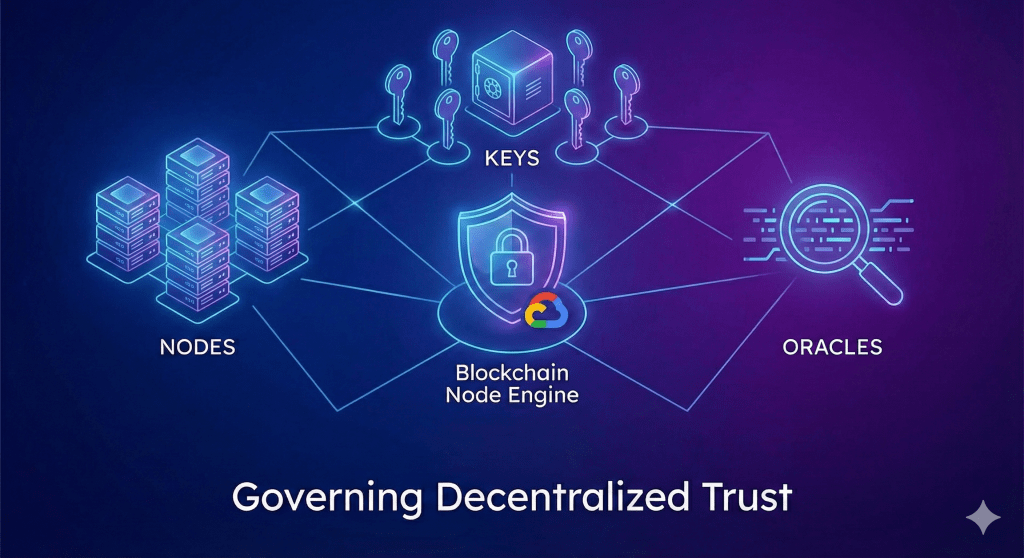
In decentralized ecosystems, trust doesn’t come from institutions, it comes from cryptography, distributed consensus, and the integrity of nodes participating in the network. But as enterprises adopt blockchain for payments, tokenization, digital assets, and cross-border trade, one reality becomes clear:
Decentralization still needs governance.
Banks, fintechs, and enterprises must secure private keys, manage validator nodes, harden oracle connections, and ensure uptime without undermining the decentralised nature of the network.
Google Cloud’s Blockchain Node Engine (BNE) emerges as a critical infrastructure layer that brings cloud-grade security to decentralized systems while preserving trust guarantees.
This article breaks down how to govern decentralized trust at scale using BNE.
1. The Governance Challenge in Decentralized Systems
Enterprises face three persistent vulnerabilities:
1️⃣ Node Security Gaps
Self-hosting blockchain nodes is costly and fragile:
- Misconfigured firewalls expose RPC endpoints
- Slow patching creates attack windows
- Unmonitored nodes go offline, impacting consensus and staking rewards
2️⃣ Key Mismanagement
Private keys are the ultimate “root of trust.” Most breaches come not from blockchain failure but key leakage.
3️⃣ Oracle Risks
Oracles link blockchains to real-world data (FX rates, ESG data, trade documents, payments). They are also:
- Attack surfaces
- Sources of manipulation
- Single points of failure if poorly governed
Decentralized trust is only as secure as its weakest link.
2. How Google Cloud’s Blockchain Node Engine Provides Trust-by-Design
BNE provides the cloud-native capability required for enterprise-grade blockchain participation.
🔐 A. Hardened Node Management
BNE automates:
- Node provisioning
- Networking
- Patching
- Autoscaling
- High availability
This eliminates human error and dramatically reduces downtime risk. Enterprises maintain decentralization while gaining cloud-level operational resilience.
3. Governing Keys: Using Cloud KMS + Confidential Computing
🔑 Key Principle: Keys must never leave secure hardware
With Google Cloud, you can:
- Store validator keys in Cloud KMS (HSM-backed)
- Use Confidential Space to ensure signing happens in secure enclaves
- Prevent operators even cloud admins from accessing private keys
This enables:
- Secure staking
- Institutional-grade custody
- On-chain transaction signing without risk of leakage
For banks and asset managers, this is mandatory.
4. Governing Oracles: Making Off-Chain Data Trustworthy
Oracles fail more often than chains. Google Cloud supports secure oracle architectures using:
📡 1. Signed Data Feeds
Oracles can sign payloads inside Confidential Space, ensuring tamper-proof data transmission.
📡 2. API Gateway + IAM
Controls which services can push or consume oracle data.
📡 3. Monitoring for Anomaly Signals
Using:
- Cloud Logging
- Cloud Monitoring
- Chronicle for threat detection
You can detect unusual patterns (e.g., sudden spikes in oracle requests).
Governance here is not optional oracles represent systemic risk in DeFi and enterprise tokenization.
5. Governance Blueprint for Decentralized Trust
Here is a simple 5-layer model you can use in banks or fintechs.
Layer 1: Node Governance
- Standardized node configurations
- SLA-driven uptime
- Zero-trust networking
- Automated patching
- Cross-region failover
Layer 2: Key Governance
- HSM-backed key storage
- Policy-based signing
- Access control & MFA
- Rotate keys regularly
- Zero administrator access
Layer 3: Oracle Governance
- Data signed in trusted execution environments
- Multi-source feeds to avoid single point of truth
- Monitoring for drift & tampering
- Fail-safe off-chain fallback
Layer 4: Audit & Lineage
- Immutable logs
- Chain-of-custody for transactions
- Provenance for data entering the chain
- Verifiable execution using Confidential Computing
Layer 5: Policy-as-Code
Implement governance rules as cloud-level guardrails:
- IAM rules
- OPA/Gatekeeper policies
- Least privilege for node operations
- Mandatory approval workflows for key usage
This ensures decentralized apps behave predictably, even under autonomous conditions.
6. Why This Matters for the Future of Digital Finance
Banks and enterprises are moving fast into:
- Tokenized deposits
- Digital bonds
- Asset-backed tokens
- Purpose-bound money
- Cross-border programmable payments
- CBDC interoperability
All of these depend on decentralized trust governed through secure nodes, secure keys, and trusted oracles. BNE provides a foundation that reduces operational risk without compromising decentralization. Trust in decentralized systems doesn’t emerge automatically. It must be engineered at the node layer, at the key layer, and at the oracle layer. Google Cloud’s Blockchain Node Engine doesn’t replace decentralization. It enables it in a way that is secure, compliant, and enterprise-ready.
The future of blockchain is decentralized. The future of decentralized trust is governed.!
 AI Academy
Leave a comment