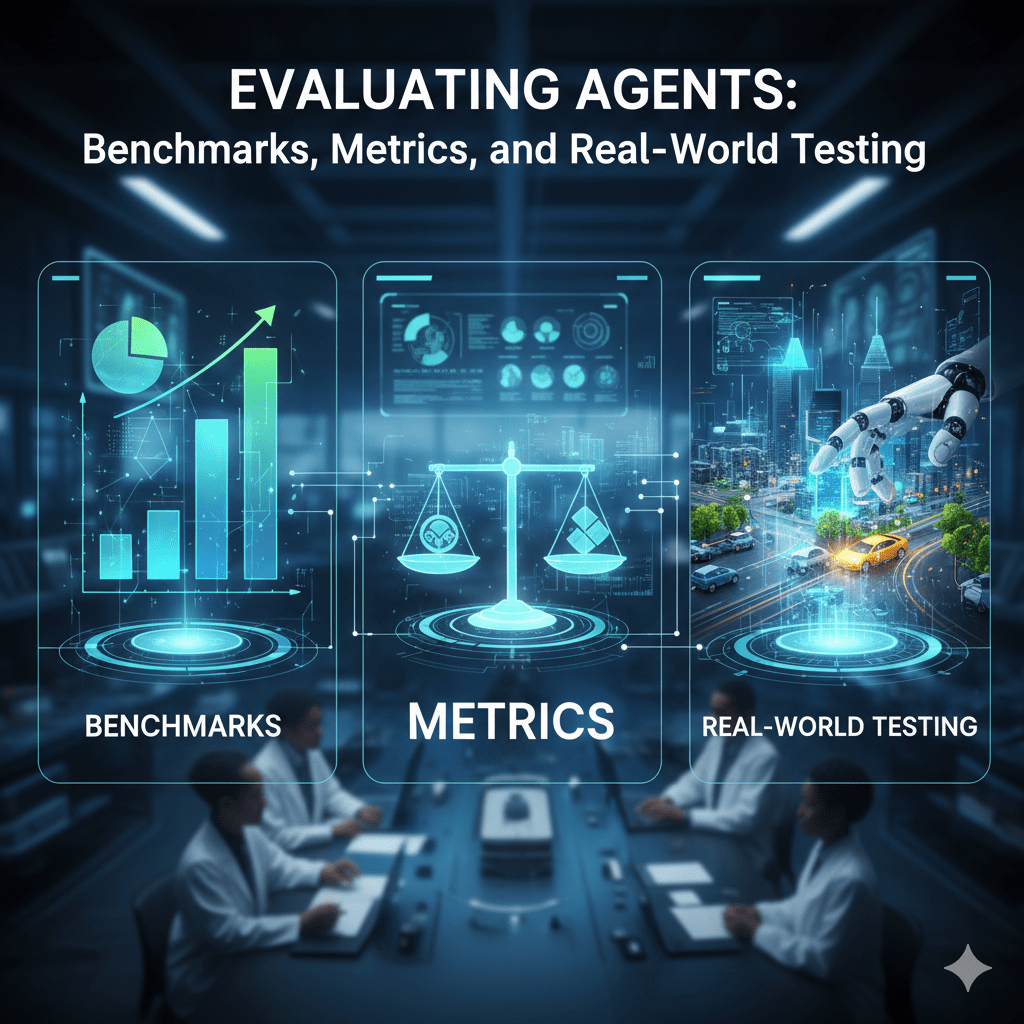
The rapid advancements in artificial intelligence have led to the proliferation of intelligent agents across various domains, from customer service chatbots and autonomous vehicles to sophisticated AI systems managing complex industrial processes. As these agents become more integrated into our daily lives and critical infrastructure, the need for robust evaluation methods becomes paramount. How do we ensure these agents are performing as expected, reliably, and safely? The answer lies in a comprehensive approach involving benchmarks, well-defined metrics, and rigorous real-world testing.
The Foundation: Benchmarks
Benchmarks serve as the standardized proving grounds for AI agents. They are pre-defined tasks or datasets designed to test specific capabilities of an agent under controlled conditions. Think of them as standardized tests for AI.
- Purpose: Benchmarks allow for objective comparison between different agents or different versions of the same agent. They provide a common ground to assess progress in the field and identify areas for improvement.
- Types:
- Task-Specific Benchmarks: These focus on a narrow range of abilities, such as natural language understanding (e.g., GLUE, SuperGLUE), image recognition (e.g., ImageNet), or game playing (e.g., Atari benchmarks).
- General Intelligence Benchmarks: More recently, efforts are underway to create benchmarks that evaluate a broader spectrum of cognitive abilities, aiming to assess “generalist” AI agents.
- Synthetic Benchmarks: These are often created in simulated environments, allowing for fine-grained control over variables and the ability to generate vast amounts of data.
- Challenges: While invaluable, benchmarks have limitations. They can sometimes lead to “teaching to the test,” where agents are optimized specifically for benchmark performance rather than true generalization. They might also not fully capture the complexity and unpredictability of real-world scenarios.
The Measure: Metrics
Metrics are the quantifiable measures used to assess an agent’s performance within a benchmark or a real-world setting. Choosing the right metrics is crucial for understanding what an agent is truly good at and where it falls short.
- Accuracy: A fundamental metric, especially in classification tasks, measuring the percentage of correct predictions.
- Precision and Recall: Important in information retrieval and anomaly detection. Precision measures the proportion of true positive results among all positive results, while recall measures the proportion of true positive results among all relevant samples.
- F1-Score: The harmonic mean of precision and recall, providing a single score that balances both.
- Latency/Throughput: Critical for real-time applications, measuring how quickly an agent responds or how many tasks it can process within a given timeframe.
- Robustness: How well an agent performs when faced with noisy, incomplete, or adversarial input data.
- Fairness: Metrics designed to assess whether an agent’s performance varies unfairly across different demographic groups, preventing bias.
- Explainability/Interpretability: While harder to quantify, metrics are emerging to evaluate how transparent and understandable an agent’s decision-making process is.
- Domain-Specific Metrics: Each application area will often have its own unique set of metrics. For instance, in autonomous driving, metrics like collision rate, comfortable braking, and adherence to traffic laws are paramount.
The Ultimate Test: Real-World Testing
While benchmarks and metrics provide a controlled environment for evaluation, the true test of an agent’s capabilities comes in the messy, unpredictable real world. Real-world testing exposes agents to unforeseen edge cases, dynamic environments, and complex human interactions that are difficult to replicate synthetically.
- Phased Deployment: Real-world testing often follows a phased approach, starting with limited deployment and gradually expanding.
- Pilot Programs: Small-scale rollouts in controlled real-world environments with close human supervision.
- A/B Testing: Comparing the performance of a new agent against an existing one (or a control group) in a live environment.
- Shadow Mode: Running an agent in parallel with human operators or existing systems, where it makes decisions but doesn’t execute them directly, allowing for observation and comparison.
- Human-in-the-Loop: For critical applications, human oversight and intervention remain crucial during real-world testing. This allows for immediate correction of errors and provides valuable qualitative feedback.
- Continuous Monitoring: Once deployed, agents require continuous monitoring to detect performance degradation, unexpected behavior, or emerging biases over time. This involves logging, anomaly detection, and regular performance reviews.
- Ethical Considerations: Real-world testing, especially with agents interacting with humans or making high-stakes decisions, necessitates careful ethical considerations, including privacy, consent, and accountability.
- Challenges: Real-world testing is expensive, time-consuming, and carries inherent risks. Reproducibility can also be a challenge due to the dynamic nature of real environments.
The Symbiotic Relationship
Benchmarks, metrics, and real-world testing are not isolated components but rather interconnected elements of a holistic evaluation strategy.
- Benchmarks inform development: They help developers identify weaknesses and improve agent architectures.
- Metrics quantify progress: They provide the granular data needed to understand how an agent is performing.
- Real-world testing validates and refines: It ensures that agents are not only theoretically capable but also practically effective and robust in the environments they are designed to operate in.
As AI agents become more sophisticated and ubiquitous, a rigorous and multi-faceted evaluation framework is indispensable. By combining the controlled rigor of benchmarks, the precision of well-chosen metrics, and the ultimate validation of real-world testing, we can build trust in AI systems and ensure they contribute positively and safely to society.
 AI Academy
Leave a comment