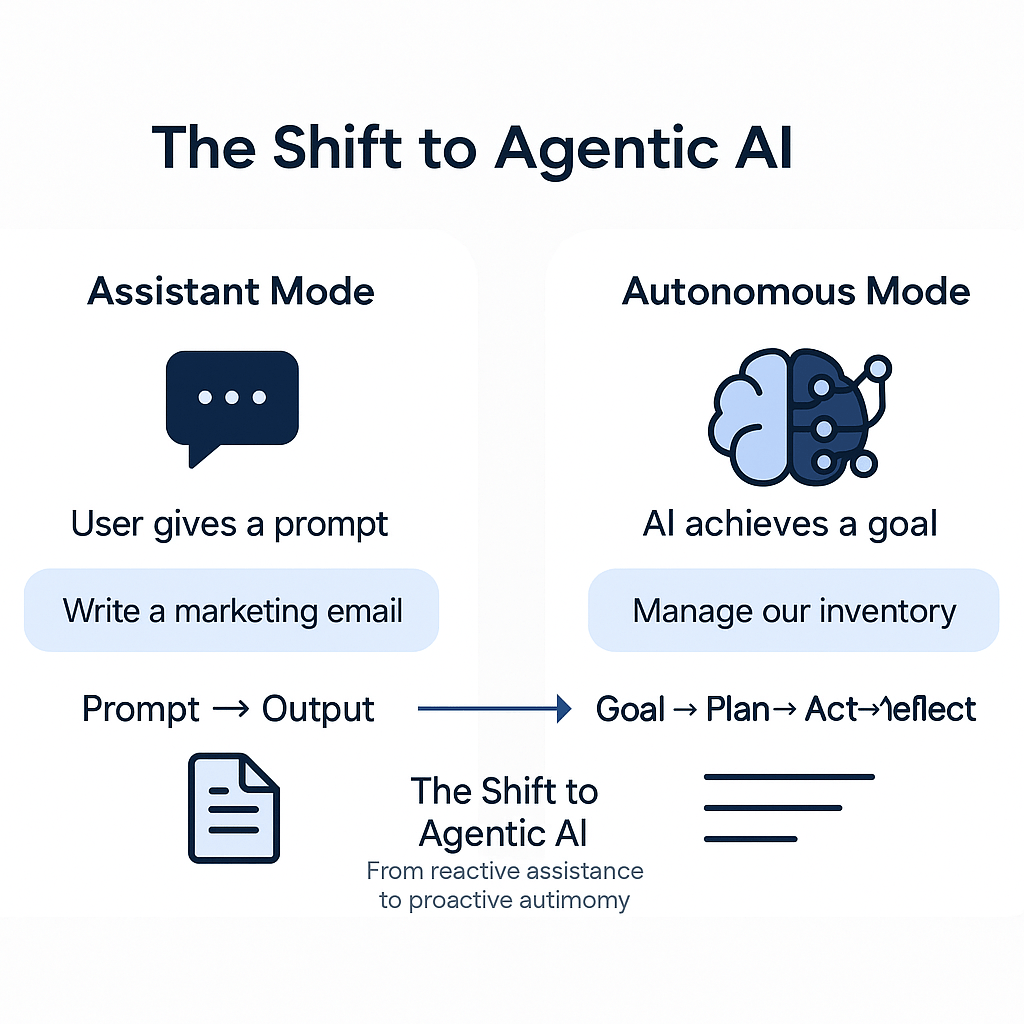
Imagine this: You walk into the office, and your AI system has already restocked your inventory, optimized delivery routes, and flagged a potential supply delay, all before your first meeting. No prompts, no dashboards, no manual triggers. Just action.
That’s Agentic AI,the next evolution beyond Generative AI.
While traditional GenAI responds to prompts (“Write me a report,” “Summarize this document”), Agentic AI pursues goals (“Prepare our monthly report and highlight anomalies,” “Manage customer feedback loops and suggest process changes”). It doesn’t wait for instructions — it thinks, plans, and executes.
Here’s what makes Agentic AI different:
- Planning: It maps out how to reach a goal step by step.
- Tool Use: It interacts with systems, APIs, and data sources to act.
- Reflection: It learns from outcomes and improves continuously.
- Autonomous Goal-Seeking: It moves toward desired results without hand-holding.
The shift is profound. We’re no longer delegating tasks, we’re delegating outcomes. Businesses can now say, “Handle our inventory,” not “List our stock.” “Manage our marketing,” not “Write a caption.”
This structural change turns AI from a co-pilot into a decision-making partner. It’s how enterprises will evolve from automation to true autonomy, where workflows run intelligently, and people focus on creativity, strategy, and growth.
Agentic AI isn’t a trend. It’s the new operating system for the modern enterprise.
At its core, Agentic AI combines four key capabilities:
- Planning: It breaks down complex goals into steps and sequences them intelligently.
- Tool Use: It interacts with APIs, databases, and systems to take real actions.
- Reflection: It evaluates its own performance and adjusts strategies in real time.
- Autonomous Goal-Seeking: It works toward objectives with minimal human oversight.
This means that instead of saying, “Write a marketing email,” a leader can now delegate, “Run our next campaign and optimize conversions.” Instead of asking, “List today’s inventory gaps,” you can direct, “Manage our inventory and restock proactively.” Agentic AI systems don’t just assist, they orchestrate.
For businesses, this marks a fundamental shift. We’re moving from prompting tools to delegating responsibility. The real power lies in integrating these agents into enterprise workflows, from finance and supply chain to HR and customer service — where they can autonomously monitor, decide, and act.
The bottom line: Agentic AI isn’t a feature upgrade; it’s a structural transformation. It’s how enterprises will move from automation to autonomy — unlocking true end-to-end intelligence across their operations.
#AgenticAI #EnterpriseAI #AutonomousSystems #GenAI #AITransformation #Automation
 AI Academy
Leave a comment