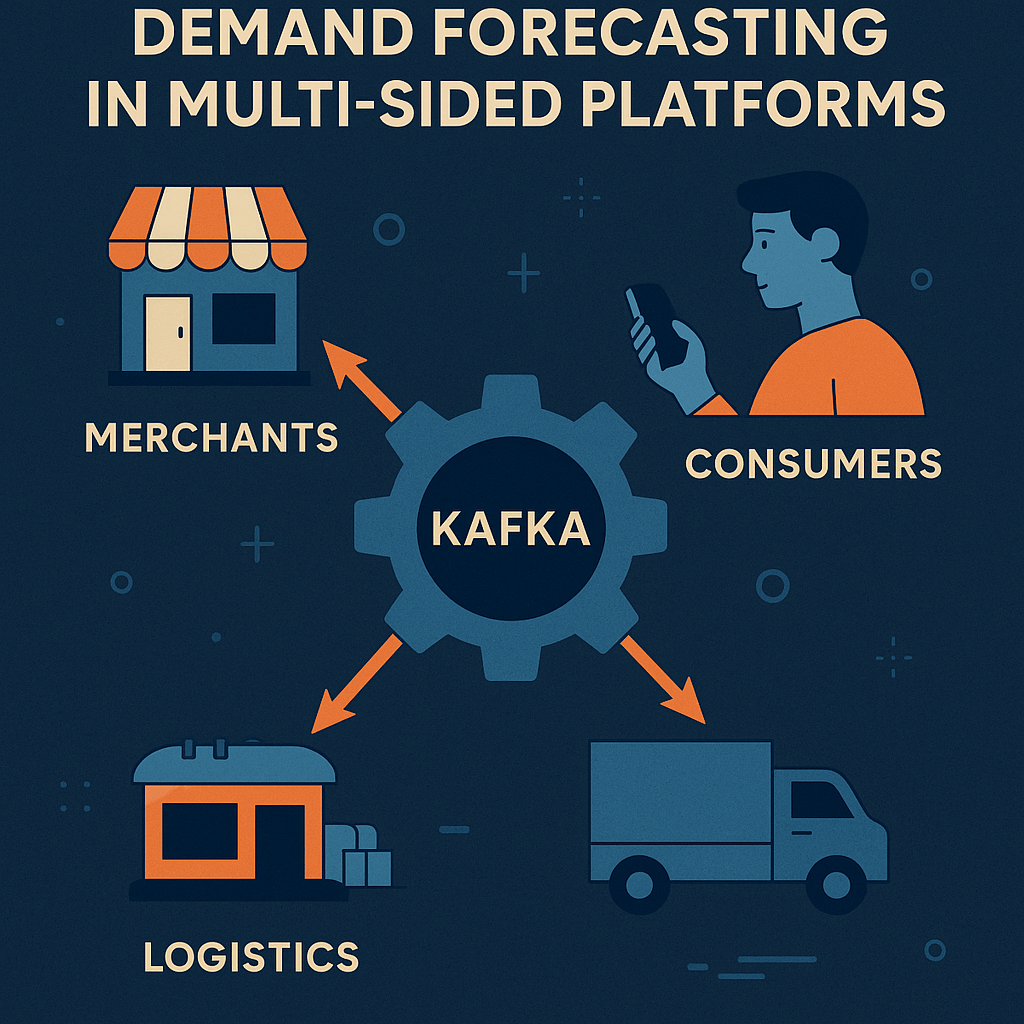
Kafka-enabled ML models predicting supply-demand shifts across networks of merchants, consumers, and logistics providers
In today’s digital economy, multi-sided platforms (MSPs), like e-commerce marketplaces, ride-hailing apps, or food delivery ecosystems—thrive on balancing supply and demand across interconnected participants. Merchants, consumers, and logistics providers all interact in real time, creating a dynamic and often volatile network.
The biggest challenge? Forecasting demand accurately across multiple sides of the platform while ensuring the supply chain can adapt instantly.
The Complexity of Multi-Sided Demand
Unlike traditional retail forecasting, demand in MSPs isn’t just about consumer purchases. It involves:
- Merchants: Inventory availability, pricing strategies, promotions.
- Consumers: Shifting preferences, seasonal behavior, purchase frequency.
- Logistics providers: Delivery capacity, geographic distribution, time windows.
These interactions form a complex feedback loop—a spike in consumer demand triggers logistics bottlenecks, which in turn affects merchant availability and consumer experience.
Why Kafka is the Backbone
To solve this forecasting challenge, platforms need real-time data streaming. This is where Apache Kafka plays a critical role:
- Unified Event Stream
Kafka captures events from all sides—orders placed, driver availability, inventory updates, delivery times—into a single, real-time data pipeline. - Low-Latency Processing
With Kafka Streams or Flink on top of Kafka, platforms can process events instantly, generating features for ML models like surge detection, demand spikes, or regional shortages. - Scalable ML Deployment
Kafka integrates with ML platforms to continuously feed fresh data into models, retrain them, and push predictions back into the system without downtime.
ML Models for Forecasting
Machine learning models trained on Kafka streams can predict:
- Consumer demand: Anticipating spikes in specific product categories or times of day.
- Supply constraints: Forecasting merchant stockouts or driver shortages.
- Network optimization: Balancing demand surges with routing and logistics availability.
For example:
- A food delivery platform can predict a dinner-time surge in pizza orders, pre-alert restaurants to prepare ingredients, and notify drivers to be on standby.
- An e-commerce marketplace can anticipate seasonal product demand (like air conditioners during a heatwave) and nudge logistics providers to allocate more capacity in specific regions.
Benefits of Kafka-Enabled Forecasting
- Real-time agility: Platforms can shift resources proactively, not reactively.
- Customer satisfaction: Better alignment of supply and demand minimizes wait times and stockouts.
- Ecosystem stability: Merchants, consumers, and logistics all benefit from smoother coordination.
The Future of Forecasting in MSPs
As multi-sided platforms grow, the role of streaming ML pipelines will only deepen. Kafka’s ability to integrate data from all participants makes it a natural backbone for real-time, AI-driven forecasting.
Ultimately, success in MSPs depends not just on scale, but on the ability to predict and balance demand dynamically—keeping every side of the platform in sync.
👉 Demand forecasting in MSPs isn’t just about predicting consumer behavior—it’s about orchestrating an entire ecosystem. With Kafka-enabled ML, platforms can move from reactive firefighting to proactive, synchronized growth.
 AI Academy
Leave a comment