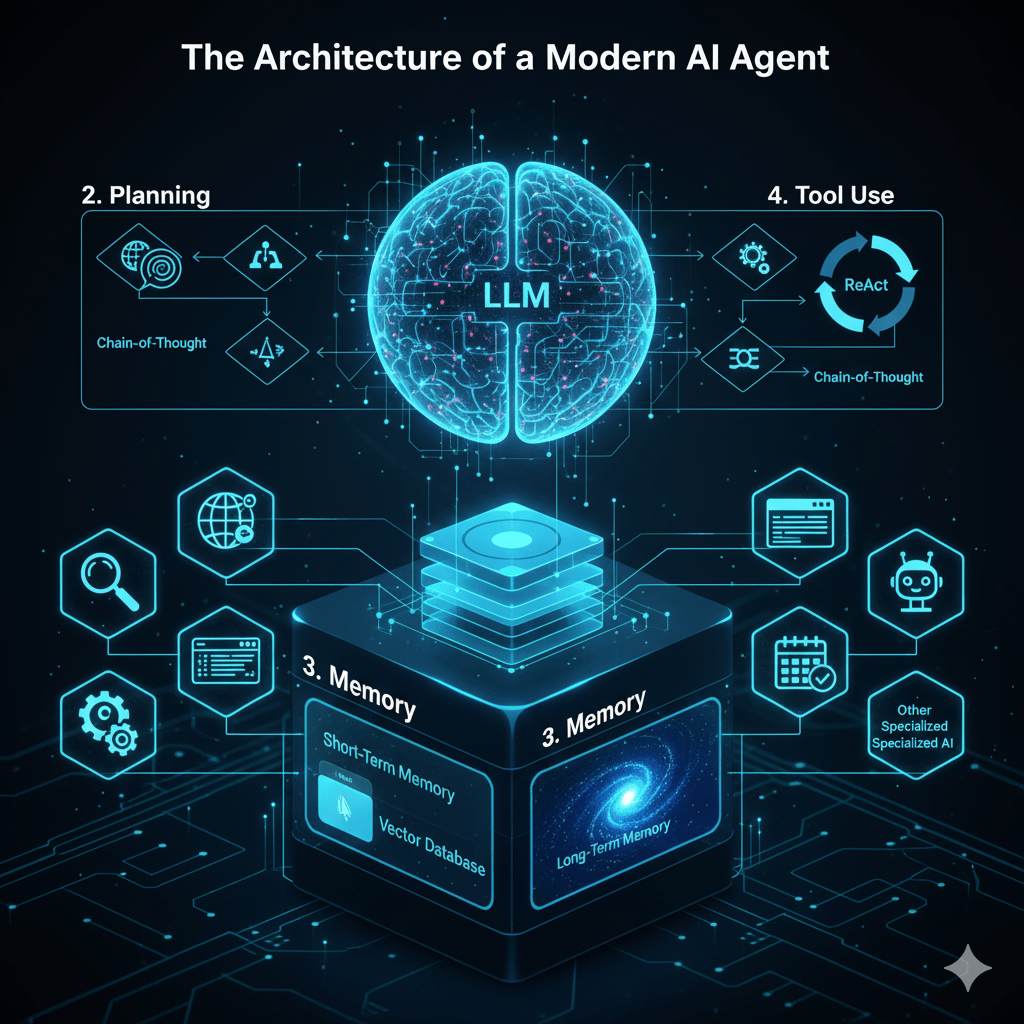
AI agents are no longer just advanced chatbots. They are systems designed to reason, plan, remember, and act, often in complex environments. To understand how they work, it helps to break down the core building blocks of a modern agentic system.
1. Planning: How Agents Decide What to Do Next
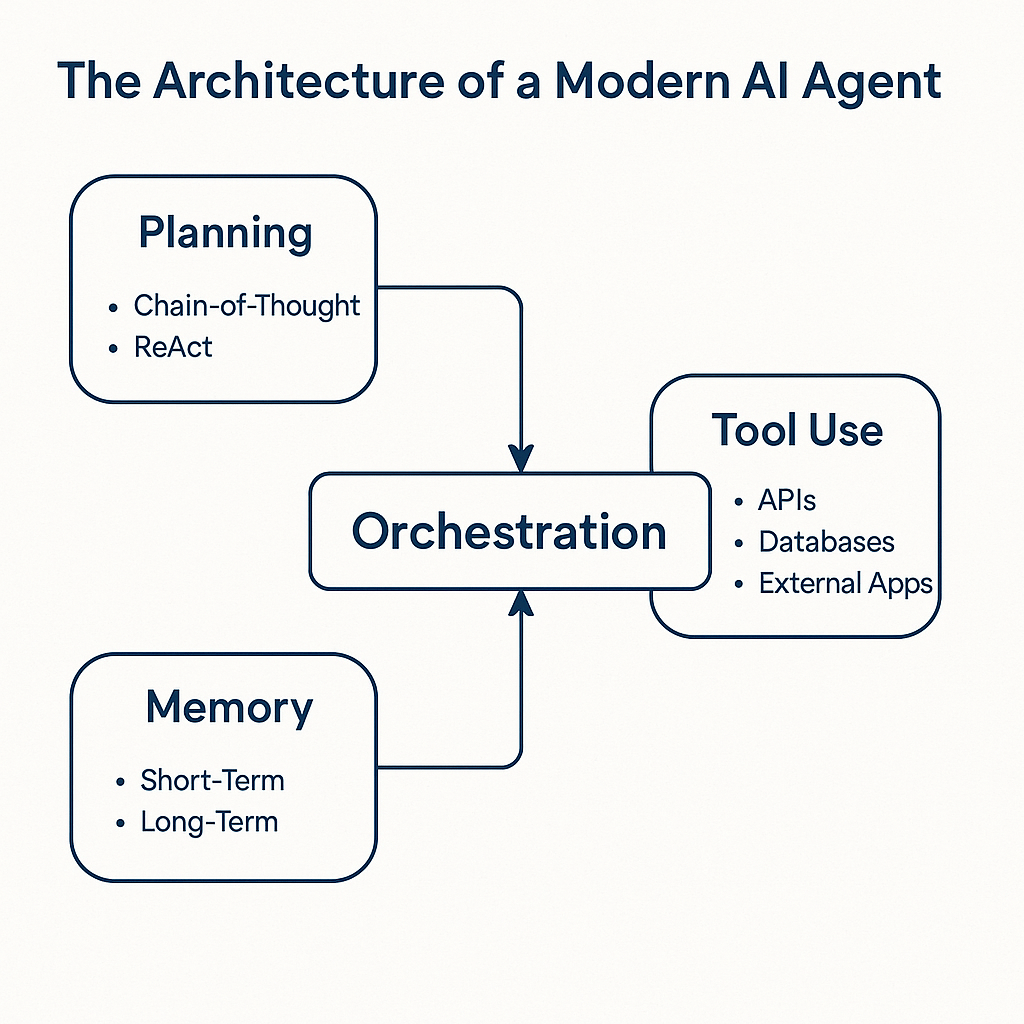
A powerful agent doesn’t just respond — it plans. Planning is the process of deciding which steps to take to reach a goal.
- Chain-of-Thought (CoT)
The agent breaks problems into smaller steps, thinking out loud to ensure reasoning is structured.
Example: Solving a math problem by writing out each step. - ReAct Framework
The agent blends reasoning with action, deciding not only what to think but also which tool to use next.
Example: While answering a travel query, the agent reasons about the location, then calls a flight API, then summarizes the result.
Why it matters: Without planning, agents risk jumping to answers too quickly or making “hallucinated” claims. Planning helps them stay logical and grounded.
2. Memory: Giving Agents Context and Continuity
Just like humans, agents need both short-term and long-term memory.
- Short-Term Memory
Captures the current conversation or task context.
Example: An AI support assistant remembering what the customer asked three questions ago. - Long-Term Memory
Stores knowledge over time in databases or vector stores, allowing recall across sessions.
Example: A personal AI coach remembering your goals, past sessions, and progress across months.
Why it matters: Memory turns agents from one-off responders into persistent companions that learn and adapt over time.
3. Tool Use: Extending Beyond Text
LLMs are powerful but limited if they only generate text. Tool use allows agents to act in the real world.
- APIs: Agents can call APIs to fetch live data like stock prices or weather updates.
- Databases: They can query knowledge bases or enterprise systems.
- External Apps: Some agents can even trigger workflows, send emails, or update records.
Example: A recruitment agent pulls a candidate’s résumé from a database, cross-checks open roles in an HR system, and emails the shortlist to a hiring manager.
Why it matters: Tool use is what makes an agent actionable. It moves beyond answering questions to actually executing tasks.
4. Orchestration: Coordinating Multiple Capabilities
Most modern agents don’t just have one capability — they orchestrate many. This means managing the interplay between reasoning, memory, and tools.
- An agent plans with Chain-of-Thought or ReAct.
- It consults memory for past interactions.
- It selects the right tool to fetch or act on data.
- It integrates the result back into the reasoning process before responding.
This orchestration loop is what allows agents to handle complex, multi-step workflows in a human-like way.
Putting It All Together
Think of a modern AI agent like a knowledgeable assistant:
- It plans its tasks like a project manager.
- It remembers context like a trusted colleague.
- It uses tools like a skilled operator.
- It orchestrates all of this seamlessly to deliver results.
The true power of agentic AI lies not in any one component but in how these parts combine into a system that learns, reasons, and acts in real time.
Why This Matters
As agents become more integrated into business and daily life, understanding their architecture is key. For enterprises, it helps evaluate trust and reliability. For developers, it provides a blueprint for building robust systems. For users, it builds confidence in how these agents “think.”
The architecture of modern AI agents is the foundation for what’s next: autonomous systems that can plan, adapt, and collaborate at scale.
 AI Academy
Leave a comment