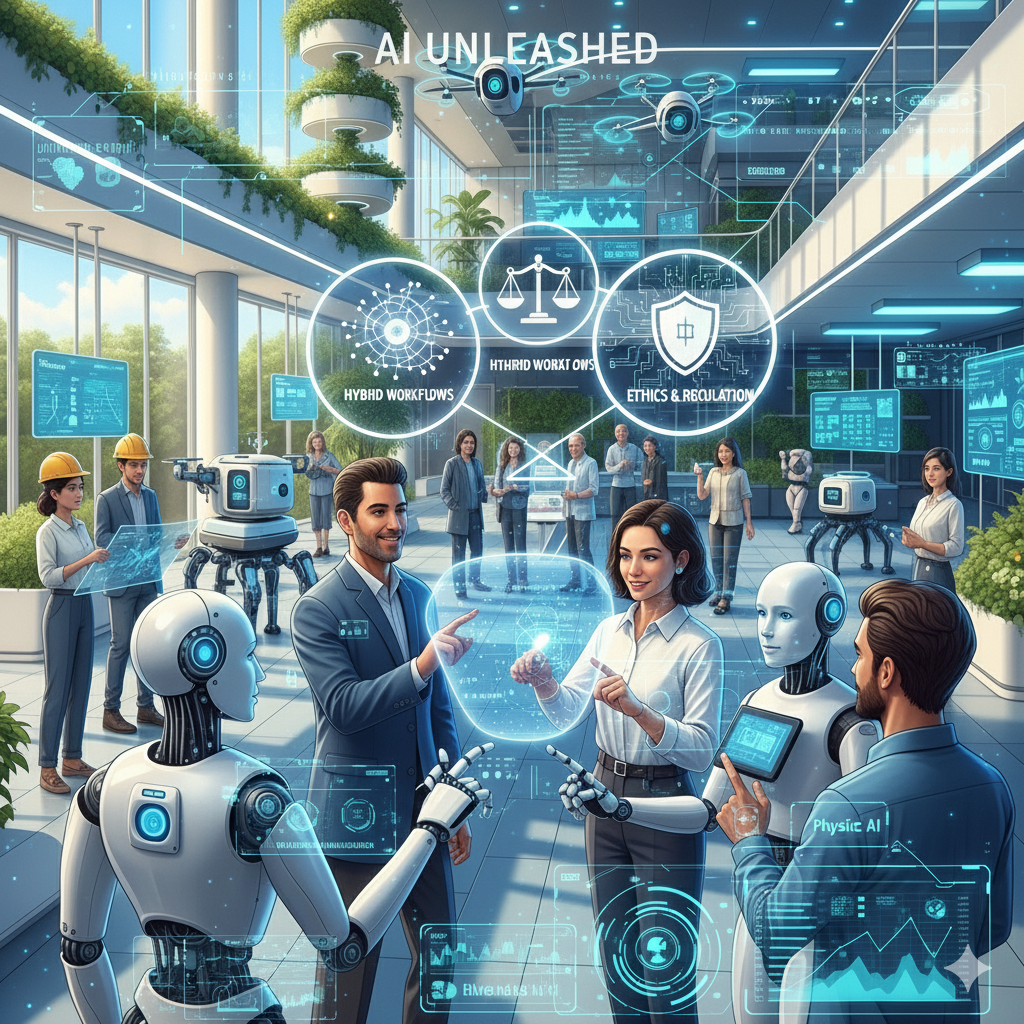
The landscape of Artificial Intelligence is shifting, and at its forefront are AI agents – autonomous systems capable of reasoning, acting, and interacting with unprecedented sophistication. As these agents become more integrated into our lives and work, a critical focus emerges: understanding the broader macro trends shaping their evolution and, most importantly, embedding strong ethical considerations into their very core. This edition of AI Unleashed dives into the currents guiding this new era of AI.
Hybrid Workflows & Human-Centered AI: Augmenting Our Potential
One of the most compelling narratives in the rise of AI agents is their potential to augment, rather than replace, human capabilities. We are moving beyond the fear of machines taking over and embracing a future where AI agents become invaluable partners.
In healthcare, AI agents can assist with diagnostics, personalize treatment plans, and even manage administrative tasks, allowing medical professionals to focus more on patient care. Imagine agents sifting through vast amounts of research to present relevant findings to a doctor in real-time.
For creative work, AI agents are proving to be powerful collaborators. From generating initial drafts of marketing copy to suggesting novel artistic compositions, they can break through creative blocks and expand the horizons of human designers, writers, and artists.
In governance, AI agents can enhance efficiency in public services, analyze policy impacts, and even streamline bureaucratic processes. Their role here is to support informed decision-making and improve the delivery of public goods, always with human oversight.
The underlying principle here is “human-centered AI” – designing systems that complement human intelligence, creativity, and empathy, fostering a more productive and fulfilling symbiotic relationship.
Ethics & Regulation: Building Trust in an Autonomous World
As AI agents gain more autonomy and influence, the imperative for robust ethical guidelines and regulatory frameworks becomes paramount. This isn’t just about preventing misuse; it’s about building societal trust and ensuring AI serves humanity’s best interests.
Transparency and Explainable AI (XAI) are no longer optional but essential. If an AI agent makes a significant decision, humans must be able to understand how and why that decision was made. This is crucial for accountability and for refining agent behavior.
The EU AI Act, set to come into force in August 2025, represents a landmark effort to regulate AI based on its potential risk level. This comprehensive framework will likely set a global standard, influencing how AI agents are developed, deployed, and governed across various sectors. Expect to see increased emphasis on data quality, human oversight, and clear responsibilities for high-risk AI systems. Such regulations are vital for creating a predictable and trustworthy environment for AI agent development.
General Trends: The Evolving Capabilities of AI Agents
Beyond the ethical and human-centric considerations, several technological trends are rapidly expanding the capabilities and applications of AI agents:
- Multimodal Interaction: Agents are increasingly able to understand and respond to various forms of input – text, speech, images, and even gestures – making their interactions more natural and intuitive.
- Memory-Augmented Agents: Giving agents the ability to retain and recall information over longer periods allows for more consistent, context-aware, and personalized interactions.
- Multi-Agent Collaboration: The emergence of systems where multiple AI agents work together, sharing information and coordinating actions, promises to unlock solutions to highly complex problems that a single agent could not address.
- Privacy-First Design: With growing data privacy concerns, agents are being developed with privacy by design principles, minimizing data collection and enhancing data protection.
- Decentralized Lifecycle Management: This trend explores how AI agents can be managed and updated in a more distributed and resilient manner, moving away from centralized control.
Looking further into the horizon, specific paradigms are poised to reshape the AI agent landscape:
- Agentic AI: This refers to the core characteristic of AI agents – their ability to act autonomously to achieve defined goals, making decisions and adapting to dynamic environments without constant human intervention. This shift from passive tools to proactive entities is fundamental.
- Physical AI: The integration of AI agents into physical forms (robots, drones, smart devices) is accelerating. These embodied agents will interact directly with the real world, performing tasks in factories, homes, and public spaces, blurring the lines between the digital and physical realms.
- Sovereign AI: This concept, highlighted by Deloitte, envisions AI agents with a high degree of autonomy, self-awareness, and control over their own resources and objectives. While exciting, this also amplifies the need for robust ethical frameworks and governance to ensure alignment with human intent.
The journey of AI agents is just beginning. As we push the boundaries of what’s possible, the convergence of advanced technical capabilities with thoughtful ethical frameworks and human-centered design will define a future where AI agents truly unleash our collective potential responsibly. The science of how agents think and act will indeed be just as important as the algorithms that power them.
 AI Academy
Leave a comment