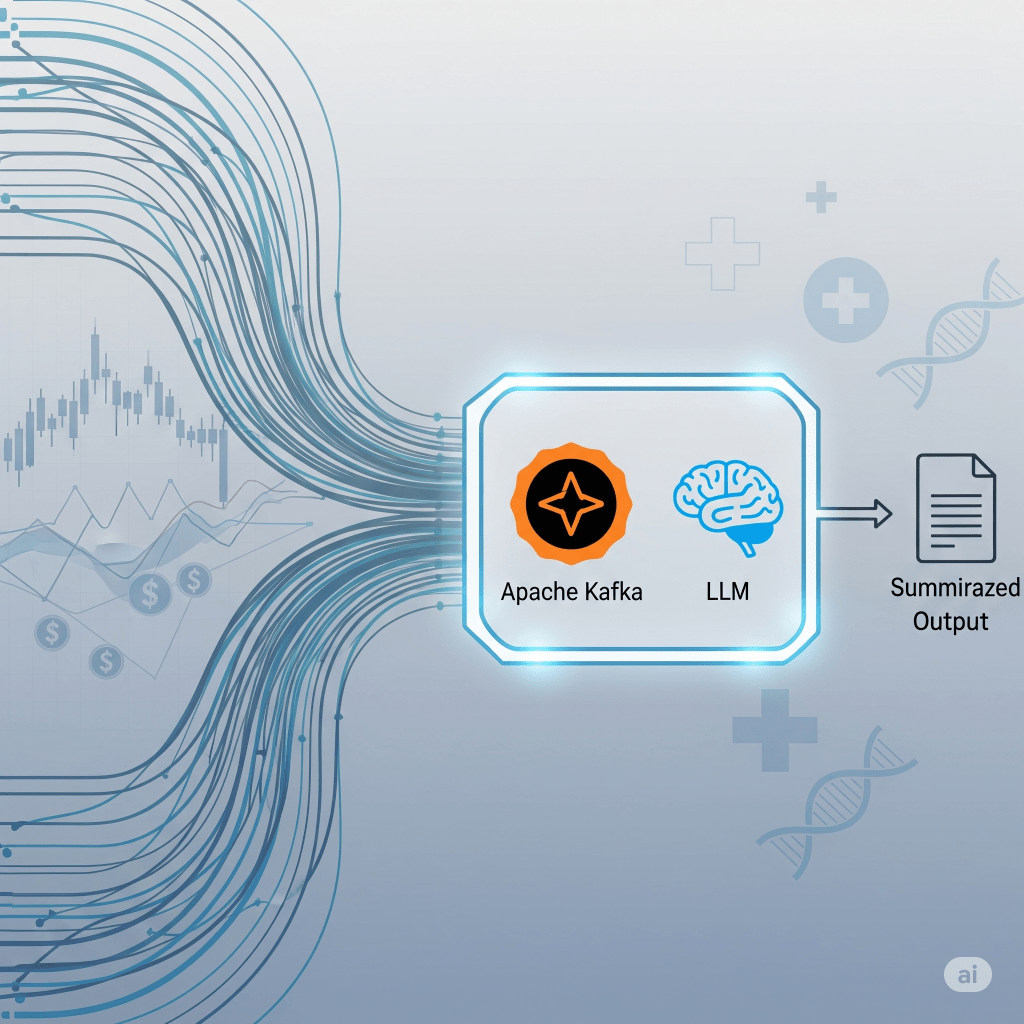
In today’s data-driven world, the ability to process and understand vast amounts of information instantly is a significant competitive advantage. Real-time document summarization is a critical technology that addresses this challenge, transforming continuous streams of data into concise, actionable summaries as they are generated. This is a leap beyond traditional batch processing, moving from looking at historical data to getting the most up-to-the-minute insights.
Why Real-Time Summarization Matters
The value of data diminishes over time. In fields like finance, healthcare, and cybersecurity, a delay of minutes or even seconds can have serious consequences. Real-time summarization is essential because it allows organizations to:
- Make faster decisions: By providing a succinct overview of live information—such as social media feeds, news wires, or sensor data—decision-makers can react to events as they unfold.
- Enhance operational efficiency: It automates the tedious task of reading long documents, freeing up human resources to focus on higher-value activities.
- Improve customer experience: It can power real-time conversational AI, providing customer service agents with instant summaries of a customer’s history and current issues.
- Prevent information overload: It filters out noise and highlights the most important details, ensuring that users are never overwhelmed by the sheer volume of incoming data.
The Technology Stack: A Pipeline for Speed
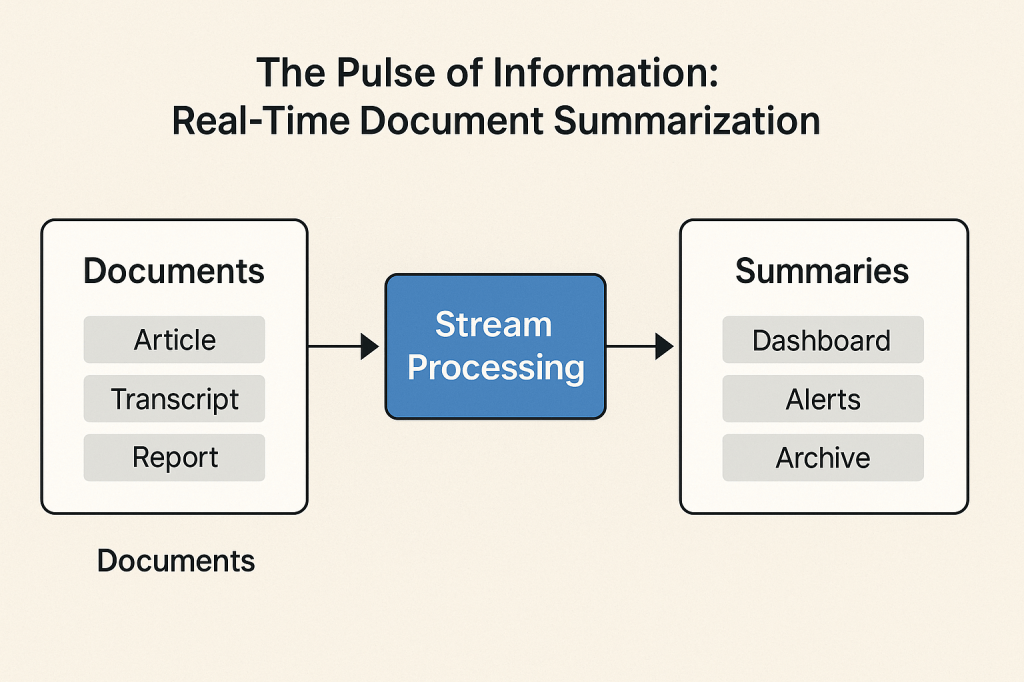
Building a real-time summarization system requires a robust and scalable architecture. Here’s a typical pipeline:
- Data Ingestion: The process begins with streaming data platforms like Apache Kafka or Amazon Kinesis. These systems are designed to ingest massive volumes of data from various sources (e.g., IoT devices, web applications, logs, social media APIs) with low latency.
- Stream Processing: The raw data is then processed in real-time using frameworks like Kafka Streams, Apache Flink, or AWS Lambda. This layer is responsible for crucial tasks like data cleansing, filtering irrelevant information, and pre-processing the text for the summarization model.
- Summarization Models: This is where the core AI magic happens. While traditional methods exist, the most effective modern systems use advanced Transformer-based models and Large Language Models (LLMs). These models can create either:
- Extractive summaries, which pull key sentences directly from the source text.
- Abstractive summaries, which generate new, human-like sentences that capture the core meaning of the document.
- Vector Databases: For use cases like Retrieval-Augmented Generation (RAG), vector databases (e.g., Pinecone, Weaviate) are crucial. Kafka continuously updates these databases with new information, ensuring the LLM has access to the most current knowledge base to avoid hallucinations.
- Output and Delivery: The final summaries are then delivered to end-users via dashboards, real-time alerts, or APIs. A key consideration here is a real-time database like Amazon DynamoDB or a time-series database for efficient storage and retrieval.
A Real-World Use Case in Healthcare
In healthcare, real-time summarization is a game-changer. Imagine a hospital where a patient’s electronic health record (EHR) is continuously updated with data from lab results, doctor’s notes, and sensor readings. A real-time summarization system could provide the following benefits:
- On-Demand Clinical Insights: When a new lab result is uploaded, the system could instantly generate a summary highlighting any critical changes from the patient’s baseline, enabling a clinician to take immediate action.
- Proactive Care: By continuously monitoring a patient’s progress notes, the system could summarize a patient’s chronological medical history, flagging key events or potential issues that might otherwise be overlooked in a long, unstructured document.
- Error Reduction: The system can quickly summarize new medication prescriptions and flag potential drug interactions by cross-referencing with the patient’s existing medication list, reducing the risk of human error.
By using real-time document summarization, healthcare providers can spend less time sifting through paperwork and more time on direct patient care, ultimately leading to better outcomes and more efficient operations.
 AI Academy
Leave a comment