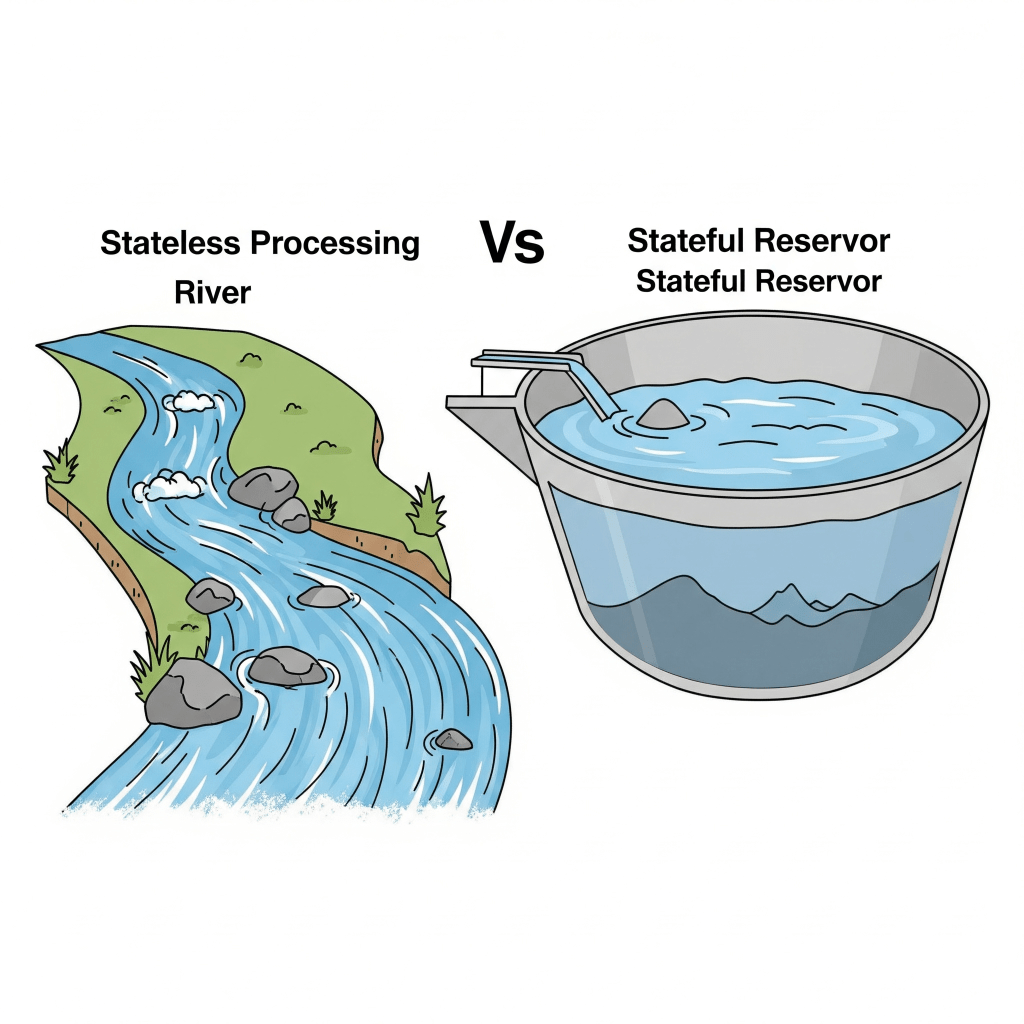
Apache Kafka has become the backbone of real-time data architectures. At its core lies Kafka Streams, a powerful client library that enables real-time processing of data streams directly within your applications. But one fundamental decision developers face is: Should I build my stream processing logic as stateless or stateful?
Understanding the tradeoffs between stateless and stateful processing is key to building scalable, fault-tolerant, and efficient streaming applications.
🔄 Stateless Kafka Streams: Let It Flow
In stateless processing, each event is processed independently, without requiring information from previous or future events.
✅ Use Case Examples:
- Filtering messages (e.g.,
filter(predicate)) - Mapping values or keys (e.g.,
map(),mapValues()) - Routing based on rules (e.g., sending messages to different topics)
- Simple transformations that don’t require aggregation or joins
✅ Pros:
- Easy to scale horizontally
- Low memory footprint
- Less complex to implement and maintain
- No need for RocksDB or state restoration
⚠️ Limitations:
- Cannot compute aggregates, joins, or windowed counts
- Not suitable for correlating across messages or time
🧠 Stateful Kafka Streams: When State Matters
Stateful processing requires Kafka Streams to remember things across records. This involves maintaining local state—backed by RocksDB—and periodically checkpointing it to Kafka for durability.
🧰 Core State Components:
- KTable: A changelog-based table abstraction for managing evolving key-value pairs.
- GlobalKTable: Like KTable, but materialized fully on each instance—great for reference data.
- RocksDB: Embedded local key-value store where Kafka Streams stores state.
- State Stores: Developer-defined or built-in stores, often backed by RocksDB.
🔁 Use Case Examples:
- Counting occurrences (e.g., word count)
- Aggregations over time windows (e.g., sum per 5-minute interval)
- Joining two streams (e.g., enrich clickstream with user profile data)
- Deduplication based on keys and time
✅ Pros:
- Enables powerful pattern recognition, aggregation, and correlation
- Can power materialized views and derived insights
- Supports exactly-once semantics in conjunction with Kafka transactions
⚠️ Challenges:
- Requires state management infrastructure
- Higher resource usage (disk/memory)
- More complex failure recovery (restoring state from changelogs)
🧮 KTable vs GlobalKTable: When to Use What
| Feature | KTable | GlobalKTable |
|---|---|---|
| Scope | Partition-local | Fully replicated on all nodes |
| Join Type | Stream-to-local-partition join | Stream-to-global-reference join |
| Performance | More scalable | Simplifies lookup logic |
| Use Case | Rolling aggregates, windowing | Enrichment from lookup tables |
🧭 When to Use Stateful vs Stateless
| Scenario | Choose… | Why |
|---|---|---|
| Filter or route based on a field | Stateless | No state needed |
| Count number of events per key | Stateful | Requires tracking counts |
| Enrich stream with profile info | Stateful | Requires join with KTable/GlobalKTable |
| Anomaly detection on individual events | Stateless | Can often be done inline |
| Fraud detection over time | Stateful | Requires tracking sequences or thresholds over time |
| User sessionization | Stateful | Involves time-windowed aggregation |
🚀 Best Practices for Stateful Streams
- Use compacted topics for KTables and changelogs.
- Monitor state size regularly to avoid memory and disk issues.
- Choose the right windowing strategy (tumbling, hopping, sliding) for temporal aggregations.
- Benchmark RocksDB tuning for large state stores.
- Scale-out wisely: partitioning impacts state locality and performance.
In Kafka Streams, stateless processing is fast and lightweight, ideal for fire-and-forget transformations. But stateful processing unlocks deep insights and business logic that depend on correlation, history, and aggregation.
The real power lies in mixing both wisely—keeping things stateless where possible, and introducing state only where it truly adds value. As your streaming architecture grows, so does the need to design with state management, observability, and scalability in mind.
 AI Academy
Leave a comment