Hey everyone, and welcome back to “AI Agents Unleashed”! We’ve talked a lot about the incredible potential of AI agents – those proactive, intelligent systems that can plan, execute, and even learn. But what truly elevates an AI agent from a sophisticated program to a truly “smart” and adaptable collaborator? The answer lies in their ability to remember, reflect, and adapt.
Just like humans, AI agents need more than just short-term memory to excel.1 They need to recall past experiences, learn from their successes and failures, and continuously refine their approach.2 This is where the concepts of memory layers, reflection mechanisms, and vector databases become game-changers.
The Power of Memory: Beyond the Current Conversation
Think of a traditional chatbot. It’s great for the immediate conversation, but if you close the chat and come back later, it’s often forgotten who you are or what you discussed. This is because it lacks robust long-term memory. For AI agents to truly be useful, especially in complex business or personal workflows, they need to retain context over extended periods, across multiple interactions, and even different tasks.3
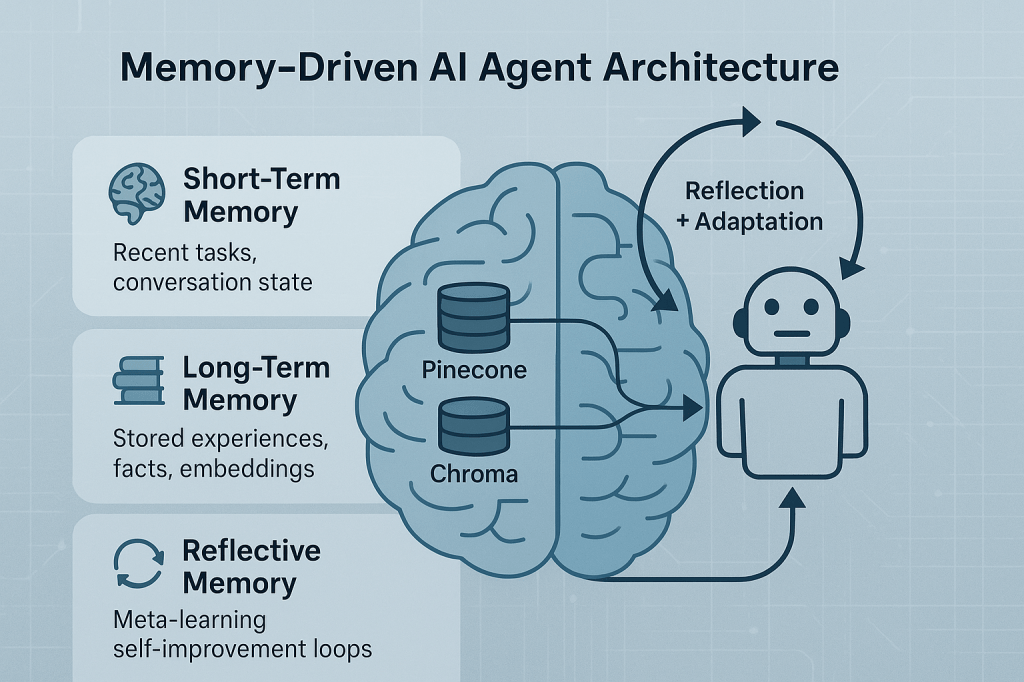
This isn’t about simply storing massive amounts of text. It’s about intelligently selecting, organizing, and retrieving information that’s relevant to the current situation.4 This is where memory layers come into play:
- Working Memory (Short-Term): This is the agent’s immediate awareness, holding the current conversation, task parameters, and recently accessed information. It’s like our short-term memory, enabling coherent responses in the moment.
- Persistent Memory (Long-Term): This is where the magic happens. It’s designed to retain knowledge across sessions, tasks, and time.5 This can include:
- Episodic Memory: Recalling specific past interactions, user preferences, or outcomes of previous tasks (“Remember how we solved that customer’s login issue last week?”).6
- Semantic Memory: Storing generalized knowledge, facts, rules, and concepts related to its domain (“What are the standard operating procedures for onboarding a new client?”).7
How Memory Layers and Vector Databases Supercharge Agent Learning
So, how do AI agents effectively manage this vast ocean of long-term memory? This is where vector databases become absolutely crucial.
- The “Embedding” Transformation: When an AI agent “remembers” something – be it a past conversation, a document, a user’s preference, or a solution to a problem – that information is first converted into a numerical representation called an embedding. These embeddings are high-dimensional vectors that capture the meaning or semantic content of the data.8 Information that is semantically similar will have embeddings that are “close” to each other in this high-dimensional space.9
- The Vector Database as a Brain’s Archive: A vector database is specially designed to store and efficiently search these embeddings.10 Unlike traditional databases that search for exact keywords, vector databases perform similarity searches.11 When an AI agent needs to recall something, it converts its current query or context into an embedding, and then queries the vector database to find other embeddings (and thus, the original information) that are semantically similar.12
- Example: If an agent is asked a question about a specific client, it can generate an embedding for that client’s name and the question. The vector database can then quickly retrieve all relevant past interactions, documents, and preferences associated with that client, even if the exact words aren’t matched.13 This allows the agent to access rich, contextual information rapidly.
Reflection: The Key to True Learning
Having memory is one thing, but truly learning from it requires reflection. This is the AI agent’s ability to “think about its thinking.” After an action or a task, a smart AI agent can:
- Self-Evaluate: Did it achieve its goal? Were there any errors or inefficiencies?
- Analyze Performance: What went well? What could be improved?
- Generate Insights: Based on its memory of past actions and outcomes, it can generate internal “lessons learned.” These reflections can then be stored back into its long-term memory (often as new embeddings in the vector database!), informing future decisions and behaviors.14
This iterative process of action, memory recall, evaluation, and reflection is what allows AI agents to continuously improve and adapt without constant human retraining.
Adaptation: Evolving with Every Interaction
With memory and reflection, AI agents gain the power of adaptation. They can:
- Personalize Interactions: By remembering user preferences and past behaviors, agents can tailor their responses and actions to individual needs.15
- Handle Novel Situations: By drawing on a broad base of past experiences and reflections, they can generalize and apply knowledge to new, unseen scenarios, rather than just relying on pre-programmed rules.16
- Optimize Strategies: They can identify patterns of success and failure, dynamically adjusting their planning and execution strategies to become more efficient and effective over time.17
The Future is Context-Aware
The integration of sophisticated memory layers and powerful vector databases, combined with reflective learning mechanisms, is propelling AI agents into a new era of intelligence. They are becoming less like static tools and more like dynamic, evolving collaborators that truly understand context, learn from experience, and adapt to an ever-changing world.18 For business leaders, this means unparalleled opportunities for automation, personalization, and efficiency.19 For tech enthusiasts, it means a fascinating frontier of innovation. And for all of us, it means a glimpse into a future where AI systems are truly smarter, more helpful, and incredibly insightful.
What kind of tasks do you envision an AI agent excelling at once it truly masters long-term memory and reflection? Let us know your thoughts!
 AI Academy
Leave a comment