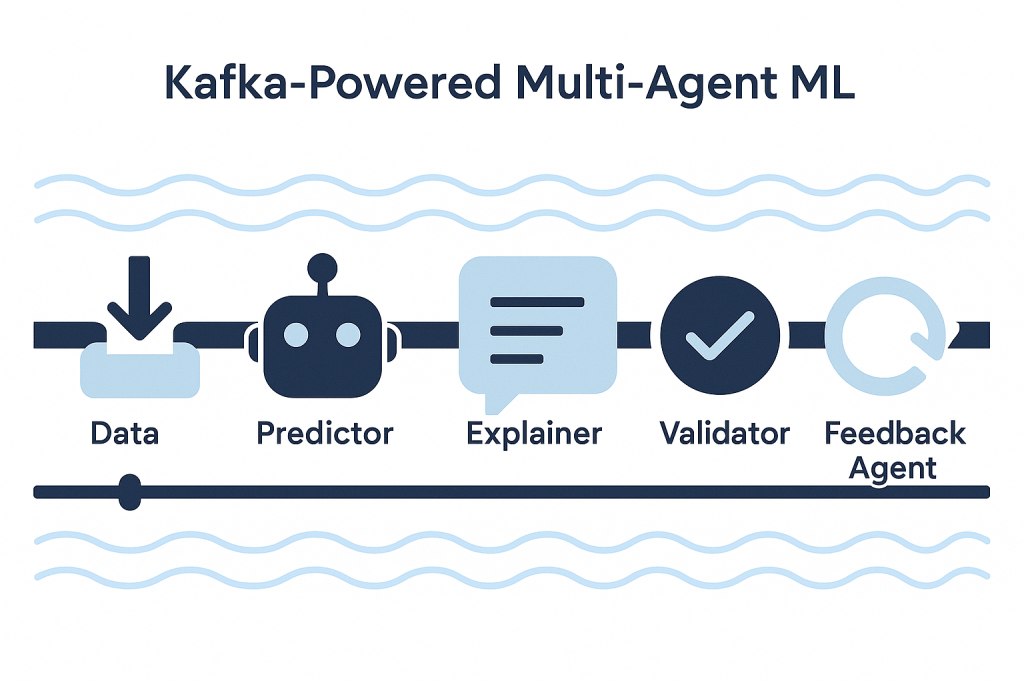
As machine learning pipelines become more complex, monolithic models are being replaced by modular, distributed agents—each with a specific role. From data collectors to model predictors, explainability agents to validators, these components need to work in concert. The challenge? Ensuring real-time coordination, traceability, and resilience.
This is where Apache Kafka shines—not just as a messaging backbone, but as the orchestration fabric that holds multi-agent machine learning systems together.
🎯 What Are Multi-Agent ML Workflows?
A multi-agent ML workflow splits responsibilities among specialized components or “agents”:
- Data Collector: Ingests and preprocesses raw data.
- Model Selector: Chooses the right model based on the context or metadata.
- Predictor: Runs inference and returns output.
- Explainer: Generates interpretability insights.
- Validator: Performs checks for drift, fairness, or confidence thresholds.
- Feedback Agent: Captures human or system feedback for retraining.
These agents need to communicate in real time—asynchronously, at scale, and with decoupling—making Kafka a perfect fit.
🧩 Kafka as the Messaging Layer
Kafka’s publish-subscribe model provides:
- Loose Coupling: Agents don’t need to know about each other directly.
- Scalability: Kafka handles millions of messages per second with fault tolerance.
- Replayability: Events can be reprocessed for audits or retraining.
- Latency Management: Stream processing ensures near real-time responses.
Each agent consumes and produces to specific Kafka topics, forming a flow:
[data.raw] → DataCollector → [data.cleaned]
[data.cleaned] → ModelSelector → [model.request]
[model.request] → Predictor → [model.output]
[model.output] → Explainer → [model.explained]
[model.output, model.explained] → Validator → [validated.results]
[validated.results] → FeedbackAgent → [training.feedback]
🔧 Example Use Case: Real-Time Credit Scoring
Imagine a real-time credit scoring system:
- DataCollector reads from
[user.transaction]. - ModelSelector evaluates features to pick a risk model (e.g., SME vs. consumer).
- Predictor scores the credit risk.
- Explainer adds human-readable rationale.
- Validator confirms thresholds and compliance.
- FeedbackAgent stores outcomes to Kafka for periodic model updates.
Each stage is decoupled, versionable, and can scale independently—thanks to Kafka.
🚀 Benefits of Kafka-Orchestrated Multi-Agent Pipelines
- Modularity: Swap out agents without breaking the pipeline.
- Observability: Tap into topics to analyze bottlenecks or failures.
- Resilience: Replay from any point in case of crash or drift detection.
- Upgradability: Test new agents in shadow mode before full deployment.
🛠️ Tools to Use with Kafka
- Apache Flink or Kafka Streams: For in-flight feature computation.
- MLflow / Kubeflow: For managing agent lifecycle and experiments.
- OpenLineage: For tracking data flow and dependencies.
- Protobuf/Avro: For schema evolution and strong typing between agents.
In a world where AI agents are becoming composable microservices, Kafka provides the communication glue. By orchestrating your ML agents over Kafka, you enable agility, traceability, and scalability—core pillars of any production-grade AI system.
The future of machine learning isn’t a single monolith. It’s a collaborative agent ecosystem—and Kafka is the message bus that powers it.
 AI Academy
Leave a comment