Telecom networks are constantly evolving to meet the increasing demands of users for faster, more reliable, and more personalized services. One of the key challenges facing telecom operators is to efficiently route traffic across their networks while ensuring optimal performance and quality of service. Traditional routing protocols are often static and inflexible, making it difficult to adapt to changing traffic patterns and network conditions.
However, the emergence of machine learning (ML) and stream processing platforms like Apache Kafka is enabling telecom operators to develop more intelligent and dynamic routing solutions. By combining the power of ML with the scalability and real-time capabilities of Kafka, telecom operators can create self-optimizing networks that can adapt to changing conditions and provide a better user experience.
How Kafka and ML can be used for intelligent routing
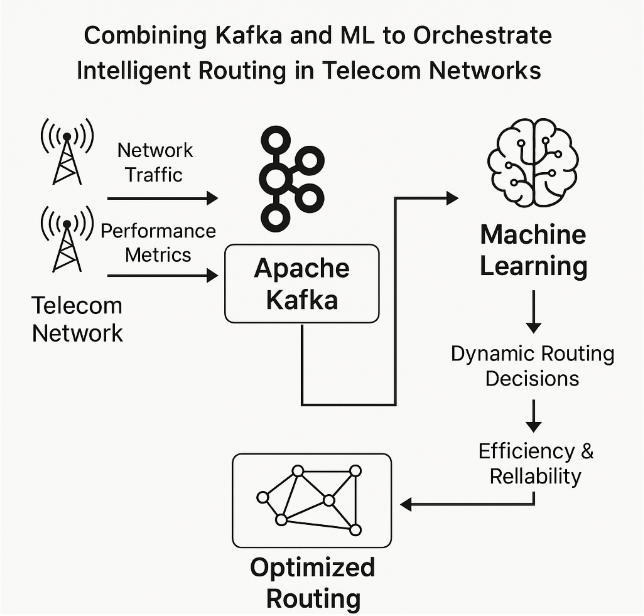
Kafka can be used to collect and stream real-time network data, such as traffic volumes, latency, and error rates. This data can then be fed into ML models that can learn to predict future traffic patterns and identify potential bottlenecks. The ML models can then be used to dynamically adjust routing decisions based on real-time network conditions.
For example, an ML model could be trained to predict the traffic load on different network links. This information could then be used to route traffic away from congested links and towards less congested ones. This would help to improve network performance and reduce latency for users.
In addition to predicting traffic patterns, ML models can also be used to detect and diagnose network problems. For example, an ML model could be trained to identify anomalies in network traffic that could indicate a problem with a network device. This information could then be used to proactively address the problem before it affects users.
Benefits of using Kafka and ML for intelligent routing
There are a number of benefits to using Kafka and ML for intelligent routing in telecom networks. These include:
- Improved network performance: By dynamically adjusting routing decisions based on real-time network conditions, Kafka and ML can help to improve network performance and reduce latency for users.
- Reduced operational costs: By automating the process of network optimization, Kafka and ML can help to reduce the need for manual intervention, which can save telecom operators time and money.
- Increased network resilience: By detecting and diagnosing network problems in real time, Kafka and ML can help to improve the resilience of telecom networks.
- Enhanced user experience: By providing a more efficient and reliable network, Kafka and ML can help to improve the user experience.
The combination of Kafka and ML is a powerful tool that can be used to orchestrate intelligent routing in telecom networks. By leveraging the real-time capabilities of Kafka and the predictive power of ML, telecom operators can create self-optimizing networks that can adapt to changing conditions and provide a better user experience. As the demand for faster and more reliable networks continues to grow, the use of Kafka and ML for intelligent routing is likely to become even more widespread.
 AI Academy
Leave a comment