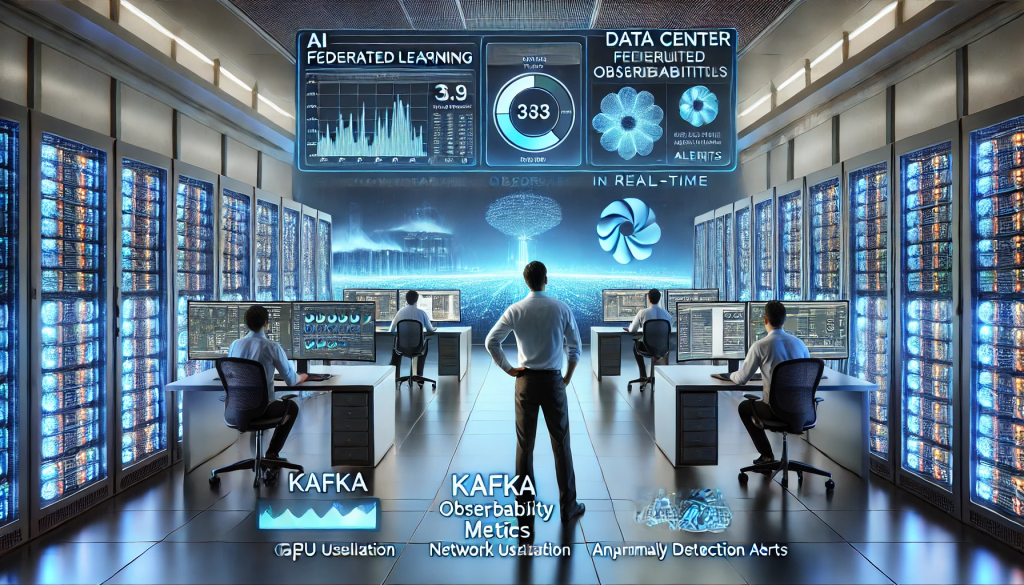
In the evolving landscape of federated learning (FL), where AI models are trained across decentralized edge devices without sharing raw data, compute observability is crucial for ensuring performance, reliability, and security. However, managing distributed learning environments at scale comes with challenges, including latency, resource utilization, fault tolerance, and real-time monitoring.
By integrating compute observability with Kafka-driven federated learning, organizations can gain real-time insights into model training, optimize resource allocation, and improve training efficiency across diverse edge environments. This article explores the importance of observability in FL and how Kafka’s real-time data streaming can enhance AI-driven federated learning systems.
1️⃣ The Role of Compute Observability in Federated Learning
Compute observability involves tracking, measuring, and analyzing system performance metrics such as CPU/GPU utilization, memory consumption, training latency, and network health in real-time. In federated learning, observability ensures that:
✅ Resource Allocation is Optimized – Prevents underutilization or overload of edge devices.
✅ Training Performance is Monitored – Identifies bottlenecks and inefficiencies in the training pipeline.
✅ Model Drift & Anomalies are Detected – Ensures AI models remain effective over time.
✅ Security & Compliance are Enforced – Detects unauthorized data access or potential adversarial attacks.
💡 Example: In healthcare FL applications, compute observability ensures that AI models are trained efficiently across distributed hospital systems while maintaining data privacy.
2️⃣ Challenges of Federated Learning Without Observability
Without real-time observability, federated learning systems face:
❌ High Latency & Inefficient Training – Delays in aggregating model updates slow down learning cycles.
❌ Unbalanced Workloads Across Edge Devices – Uneven resource distribution leads to computational inefficiencies.
❌ Security Risks & Data Leakage – Lack of monitoring can expose FL systems to adversarial attacks.
❌ Difficult Debugging & Troubleshooting – Identifying failures across multiple edge nodes becomes complex.
To overcome these challenges, Kafka-driven observability provides a scalable and real-time monitoring layer for federated learning.
3️⃣ Why Kafka for Federated Learning Observability?
Apache Kafka, known for its high-throughput real-time data streaming, plays a key role in federated learning observability by:
📡 Streaming System Metrics in Real Time – Tracks CPU/GPU performance, latency, and error logs from distributed edge nodes.
📊 Processing and Aggregating Model Updates Efficiently – Ensures federated model updates are delivered reliably.
🔍 Detecting Anomalies & Failures Instantly – AI-driven anomaly detection in Kafka helps identify resource bottlenecks.
🔄 Ensuring Secure & Compliant Model Training – Kafka enables event-driven alerts for security breaches and performance degradation.
💡 Example: A financial institution using FL for fraud detection can leverage Kafka to monitor training workloads across multiple regions and automatically detect anomalies in model performance.
4️⃣ Architecture: Kafka-Driven Compute Observability for FL
An effective Kafka-driven federated learning observability system consists of:
1️⃣ Federated Learning Clients (Edge Nodes): Train local AI models and send performance logs.
2️⃣ Kafka Producers (Edge Agents): Stream observability data (resource usage, errors, model updates) to Kafka.
3️⃣ Kafka Brokers (Real-Time Pipeline): Manage message ingestion and event processing.
4️⃣ Kafka Consumers (Observability Dashboards & AI Monitors):
- AI-based anomaly detection alerts.
- Real-time visualization of compute performance.
- Automated resource scaling based on workload patterns.
💡 Example: Google’s FL-based AI models could use Kafka to monitor thousands of IoT devices, ensuring efficient model training across a global network.
5️⃣ Future of Compute Observability in Federated Learning
🔮 AI-Driven Observability: Self-optimizing FL models using AI-powered workload balancing.
🔮 Federated Anomaly Detection: Detecting security breaches in FL environments with distributed AI monitoring.
🔮 Real-Time Adaptive Training: Dynamic resource allocation based on Kafka-powered observability analytics.
🚀 Conclusion: By integrating compute observability with Kafka-driven federated learning, organizations can achieve scalable, efficient, and secure AI training across distributed environments.
💬 What are your thoughts on Kafka’s role in federated learning? Let’s discuss below! 👇
 AI Academy
Leave a comment