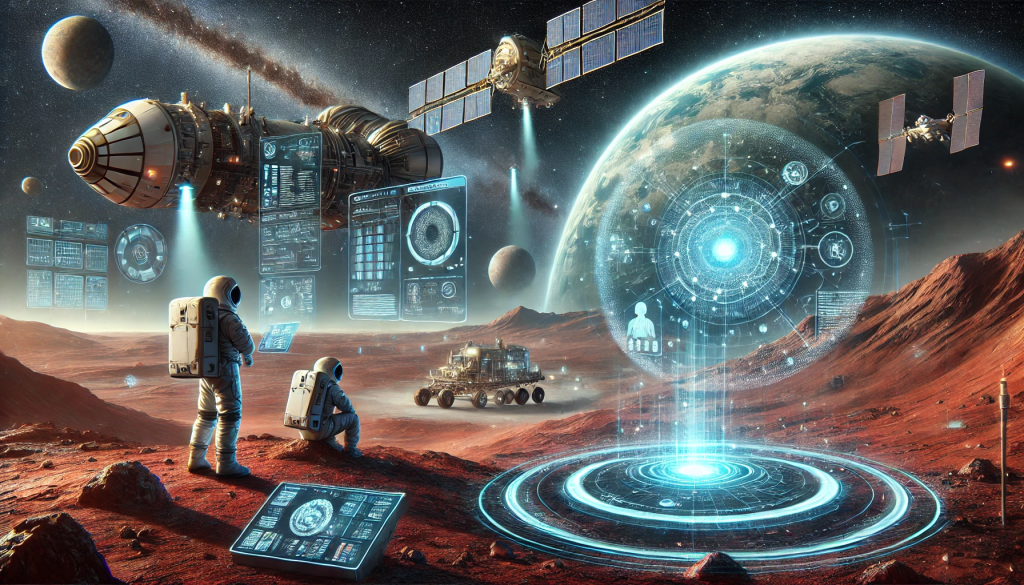
Artificial Intelligence (AI) is revolutionizing space exploration, enabling missions that were once impossible. From autonomous spacecraft to AI-driven planetary exploration, AI is helping us navigate the vastness of space, analyze cosmic data, and uncover the secrets of the universe.
In this article, we’ll explore how AI is transforming space research, improving mission success rates, and redefining humanity’s place in the cosmos. 🌌
1️⃣ AI-Powered Autonomous Spacecraft & Rovers
Space missions often face unpredictable challenges, from harsh environments to communication delays with Earth. AI is making spacecraft and rovers more autonomous and self-sufficient.
🚀 AI-Driven Space Navigation:
- AI enables autonomous spacecraft navigation, reducing reliance on real-time commands from Earth.
- NASA’s Perseverance Rover uses AI to plan efficient routes and avoid obstacles on Mars.
🛸 Smart Robotics for Planetary Exploration:
- AI allows rovers to adapt to dynamic environments and explore rough terrains.
- The ESA’s ExoMars rover uses AI to analyze soil composition for signs of life.
💡 Example: The Viper Rover (NASA) will use AI to search for water ice on the Moon’s south pole, aiding future lunar colonization.
2️⃣ AI in Deep Space Observation & Astronomy
AI is revolutionizing our understanding of the universe, processing vast amounts of cosmic data that would take humans decades to analyze.
🔭 AI-Powered Telescopes:
- AI helps astronomers detect exoplanets, supernovae, and black holes from massive datasets.
- The James Webb Space Telescope (JWST) uses AI algorithms to enhance image processing.
🧠 AI for Cosmic Pattern Recognition:
- AI models analyze gravitational waves to study distant galaxies.
- Machine learning identifies habitable exoplanets from space telescope data.
💡 Example: Google’s AI discovered two new exoplanets by analyzing Kepler Space Telescope data—proving AI’s role in expanding our cosmic knowledge.
3️⃣ AI for Mission Control & Spacecraft Maintenance
Managing space missions requires constant monitoring and rapid decision-making. AI enhances mission control by:
🛰️ Predictive Maintenance in Spacecraft:
- AI detects anomalies in spacecraft systems, preventing mission failures.
- NASA’s AI-driven health monitoring system helps maintain the International Space Station (ISS).
📡 AI in Satellite Operations:
- AI automates satellite positioning and collision avoidance in orbit.
- AI optimizes Earth observation satellites for climate and environmental monitoring.
💡 Example: SpaceX’s Starlink satellites use AI for collision avoidance, ensuring smooth operation in low Earth orbit.
4️⃣ AI in Space Communication & Data Transmission
Space exploration involves huge data transmissions across vast distances. AI optimizes data handling to improve:
📡 Interplanetary Communications:
- AI enhances signal processing for faster space-to-Earth communication.
- AI helps process radio signals from deep space missions.
🔗 Data Compression & Analysis:
- AI compresses and prioritizes space data, ensuring only the most valuable insights are sent back to Earth.
- AI-based image enhancement improves visuals from space telescopes and rovers.
💡 Example: NASA’s Mars Reconnaissance Orbiter (MRO) uses AI to select and send only the best images, saving bandwidth.
5️⃣ AI for Space Colonization & Future Missions
As space agencies plan for lunar bases, Mars colonization, and interstellar travel, AI will be crucial in:
🏠 AI-Designed Space Habitats:
- AI optimizes resource allocation for life-support systems on Mars or the Moon.
- AI assists in 3D printing structures from lunar or Martian soil.
🧬 AI for Human Health in Space:
- AI monitors astronaut health and predicts potential medical issues.
- AI-powered robotic assistants support astronauts during missions.
💡 Example: NASA’s Robonaut is an AI-powered humanoid designed to assist astronauts aboard the ISS.
🔮 The Future of AI in Space Exploration
🚀 AI will play a key role in interstellar missions, assisting in:
- Autonomous AI-driven space probes exploring deep space.
- AI-controlled Mars habitats ensuring human survival on the Red Planet.
- Machine learning-powered SETI research to detect extraterrestrial intelligence.
AI is not just a tool—it’s a mission enabler, pushing the boundaries of what’s possible beyond Earth. 🌠
💬 What excites you most about AI’s role in space exploration? Let’s discuss! 👇
 AI Academy
Leave a comment