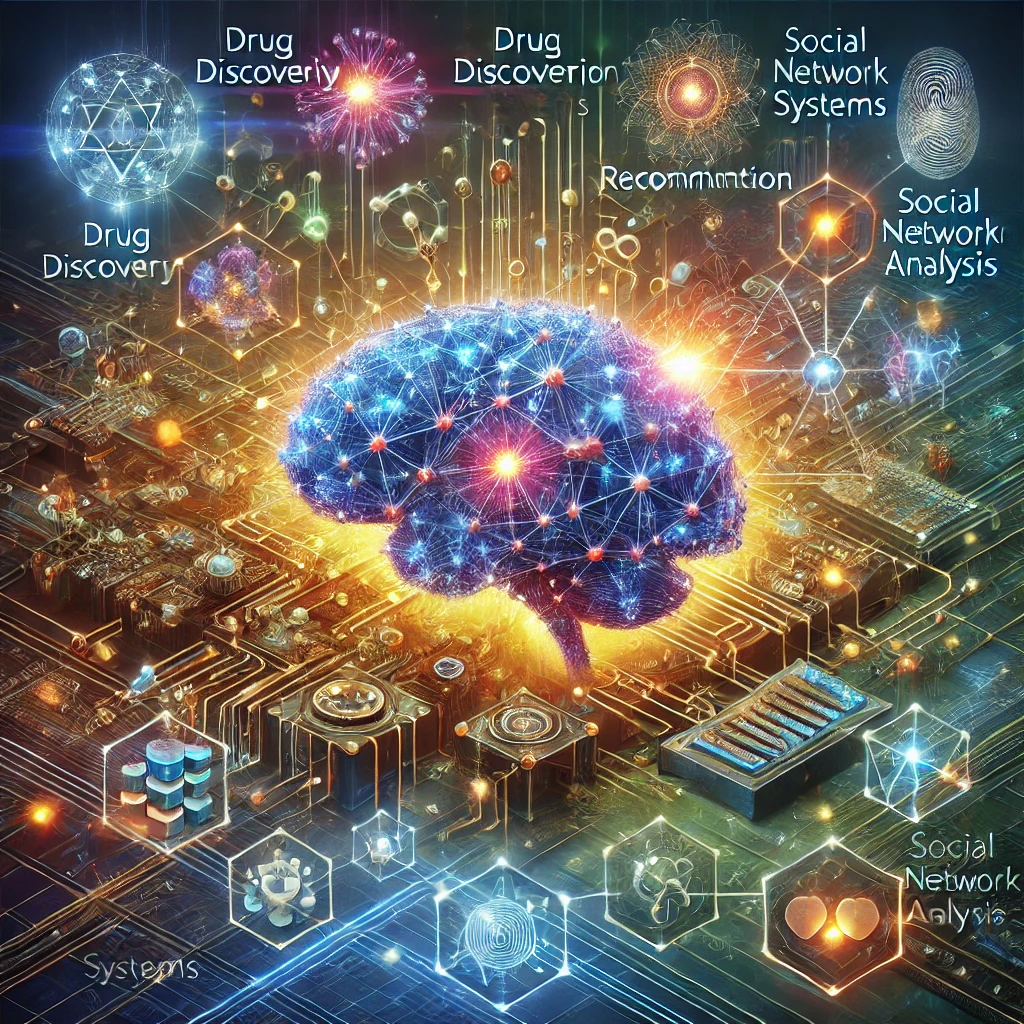
Generative AI has emerged as a transformative force across industries, enabling advancements in content creation, recommendation systems, and scientific discovery. At the heart of these innovations lies data and its intricate relationships. Graph mining, a technique for analyzing structured data represented as graphs, has become a crucial tool for enhancing the capabilities of Generative AI. This article explores how graph mining powers Generative AI applications and outlines future directions for leveraging this synergy.
The Role of Graph Mining in Generative AI
Graphs provide a natural way to represent relationships in data, making them indispensable for certain Generative AI tasks. Graph mining focuses on discovering patterns, structures, and insights from graph-based data. When integrated with Generative AI models, these capabilities can significantly enhance their understanding of relationships, dependencies, and structures.
Applications of Graph Mining in Generative AI
- Recommendation Systems
- How it works: Graph mining is used to model relationships between users, items, and their interactions. Techniques like node embeddings and graph convolutional networks (GCNs) improve recommendations.
- Example: Netflix and Spotify use graph-based approaches to provide personalized recommendations by analyzing user-item interaction graphs.
- Knowledge Graphs in NLP
- How it works: Knowledge graphs provide structured context to Generative AI models by linking entities and their relationships. Graph mining techniques enhance the construction and querying of these graphs.
- Example: Large language models like GPT can answer questions more accurately when augmented with knowledge graphs.
- Drug Discovery and Healthcare
- How it works: Graph mining identifies patterns in biological networks and molecular structures, aiding in the discovery of new drugs and treatments.
- Example: Generative models like AlphaFold leverage graph representations to predict protein structures.
- Social Network Analysis
- How it works: Social graphs represent connections and interactions between individuals. Graph mining can uncover trends, influencers, and community structures, which inform content generation and personalization.
- Example: Platforms like Facebook and Twitter use graph-based insights to curate content feeds and targeted advertising.
- Fraud Detection
- How it works: Graph mining detects anomalous patterns in financial transaction networks or supply chain systems, enhancing the robustness of Generative AI in fraud prevention.
- Example: Banks use graph-based approaches to identify unusual patterns in payment networks.
Challenges and Future Directions
- Scalability
- Challenge: Large-scale graphs with billions of nodes and edges require significant computational resources.
- Future Direction: Developing distributed and efficient algorithms to handle massive graphs.
- Integration with Generative Models
- Challenge: Seamless integration of graph mining insights into transformer-based architectures is complex.
- Future Direction: Creating hybrid models that natively incorporate graph structures and learn from graph-based features.
- Bias and Fairness
- Challenge: Graph-based datasets can inherit biases, leading to unfair outcomes in Generative AI applications.
- Future Direction: Researching fairness-aware graph mining techniques to mitigate biases.
- Real-Time Graph Processing
- Challenge: Real-time graph analysis is necessary for dynamic applications like fraud detection or personalized recommendations.
- Future Direction: Building real-time graph mining frameworks that can adapt to changing data.
- Explainability
- Challenge: Explaining decisions made by models leveraging graph mining is often opaque.
- Future Direction: Focusing on explainable AI (XAI) methods tailored for graph-based models.
Graph mining is a powerful tool for enhancing the capabilities of Generative AI. By uncovering complex relationships in data, it enables applications ranging from personalized recommendations to groundbreaking discoveries in healthcare. However, to fully harness its potential, future research must address scalability, integration, and ethical challenges. As the field evolves, the synergy between graph mining and Generative AI promises to redefine innovation across industries.
 AI Academy
Leave a comment