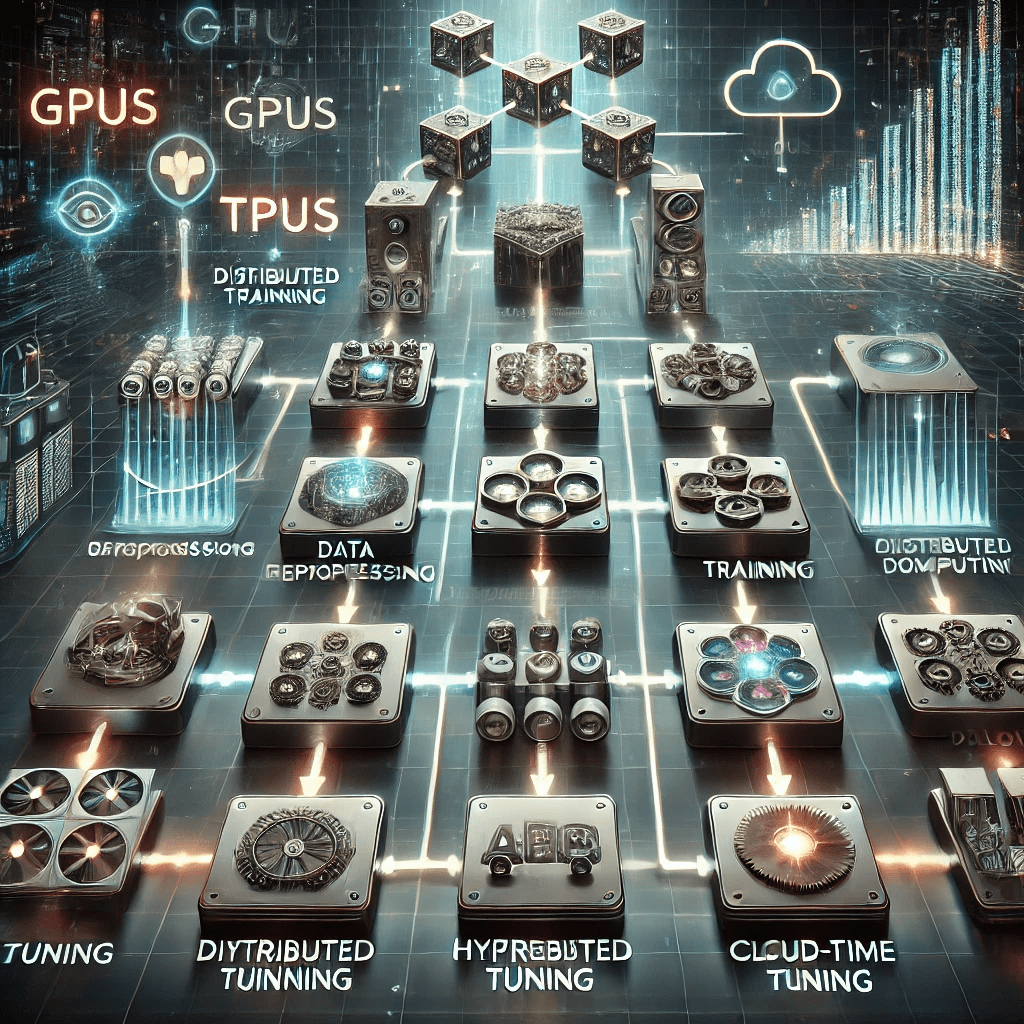
The rise of foundation models—large-scale machine learning models pre-trained on diverse datasets—has revolutionized the AI landscape. These models, such as Gemini, GPT, BERT, and DALL-E, power applications ranging from natural language processing to image generation. However, building and deploying these models at scale requires robust and efficient machine learning pipelines. This article outlines best practices for constructing large-scale machine learning pipelines tailored to foundation models.
Understanding the Challenges of Scaling Foundation Models
Foundation models are resource-intensive and complex, posing unique challenges:
- Data Volume and Diversity: Handling massive and heterogeneous datasets efficiently.
- Compute Intensity: Managing the substantial computational resources required for training and inference.
- Scalability: Building pipelines that scale with model size and data growth.
- Monitoring and Debugging: Ensuring reliability and robustness during deployment.
- Reproducibility: Maintaining consistency across training and evaluation runs.
Best Practices for Building Large-Scale ML Pipelines
- Data Management
- Data Versioning: Use tools like DVC (Data Version Control) to version and track dataset changes.
- Distributed Data Storage: Leverage scalable storage solutions such as cloud object stores (e.g., AWS S3, Google Cloud Storage).
- Data Preprocessing Pipelines: Automate data cleaning, normalization, and augmentation using frameworks like Apache Beam or TensorFlow Data Service.
- Scalable Compute Infrastructure
- Distributed Training: Utilize distributed computing frameworks like PyTorch’s DDP (Distributed Data Parallel) or Horovod to parallelize training across GPUs and TPUs.
- Resource Optimization: Implement mixed-precision training to reduce memory usage and training time.
- Elastic Scaling: Use Kubernetes or cloud-native solutions to dynamically scale compute resources based on workload.
- Model Training and Fine-Tuning
- Checkpointing: Regularly save checkpoints to resume training in case of interruptions.
- Hyperparameter Tuning: Automate hyperparameter optimization using tools like Optuna or Ray Tune.
- Transfer Learning: Fine-tune foundation models on domain-specific data to reduce computational overhead.
- Pipeline Automation
- Workflow Orchestration: Use orchestration tools like Kubeflow, Airflow, or MLflow to automate end-to-end workflows.
- CI/CD for ML: Implement continuous integration and deployment pipelines for faster experimentation and deployment.
- Modular Design: Break down the pipeline into reusable modules for data ingestion, model training, and deployment.
- Monitoring and Observability
- Model Monitoring: Track metrics such as accuracy, latency, and drift using tools like Prometheus or Evidently AI.
- System Logging: Collect system logs for debugging and performance analysis.
- Alerting Systems: Set up alerts for anomalies in model behavior or system performance.
- Reproducibility and Experiment Tracking
- Experiment Tracking: Use tools like Weights & Biases or Neptune.ai to log and compare experiment results.
- Environment Management: Standardize environments using Docker or Conda for consistency.
- Code Versioning: Leverage Git to version code and collaborate effectively.
- Deployment Best Practices
- Model Optimization: Use techniques like model pruning or quantization to reduce model size and latency.
- Scalable Serving: Deploy models with frameworks like TensorFlow Serving, TorchServe, or cloud-native solutions (e.g., Vertex AI, SageMaker).
- Batch and Real-Time Inference: Design pipelines that support both batch processing and real-time inference based on application needs.
Emerging Trends in ML Pipelines for Foundation Models
- Federated Learning Pipelines: Building pipelines for decentralized training across multiple devices while preserving data privacy.
- Serverless ML Pipelines: Leveraging serverless architectures to simplify scaling and reduce operational complexity.
- Data-Centric AI: Shifting focus from model-centric to data-centric approaches for improving model performance.
- Edge Deployment: Optimizing pipelines for deploying foundation models on edge devices for low-latency applications.
Building large-scale machine learning pipelines for foundation models is a complex but rewarding endeavor. By adopting best practices in data management, compute infrastructure, automation, and monitoring, organizations can harness the full potential of these powerful models. As technology evolves, staying abreast of emerging trends and tools will ensure that your pipelines remain efficient, scalable, and robust.
 AI Academy
Leave a comment