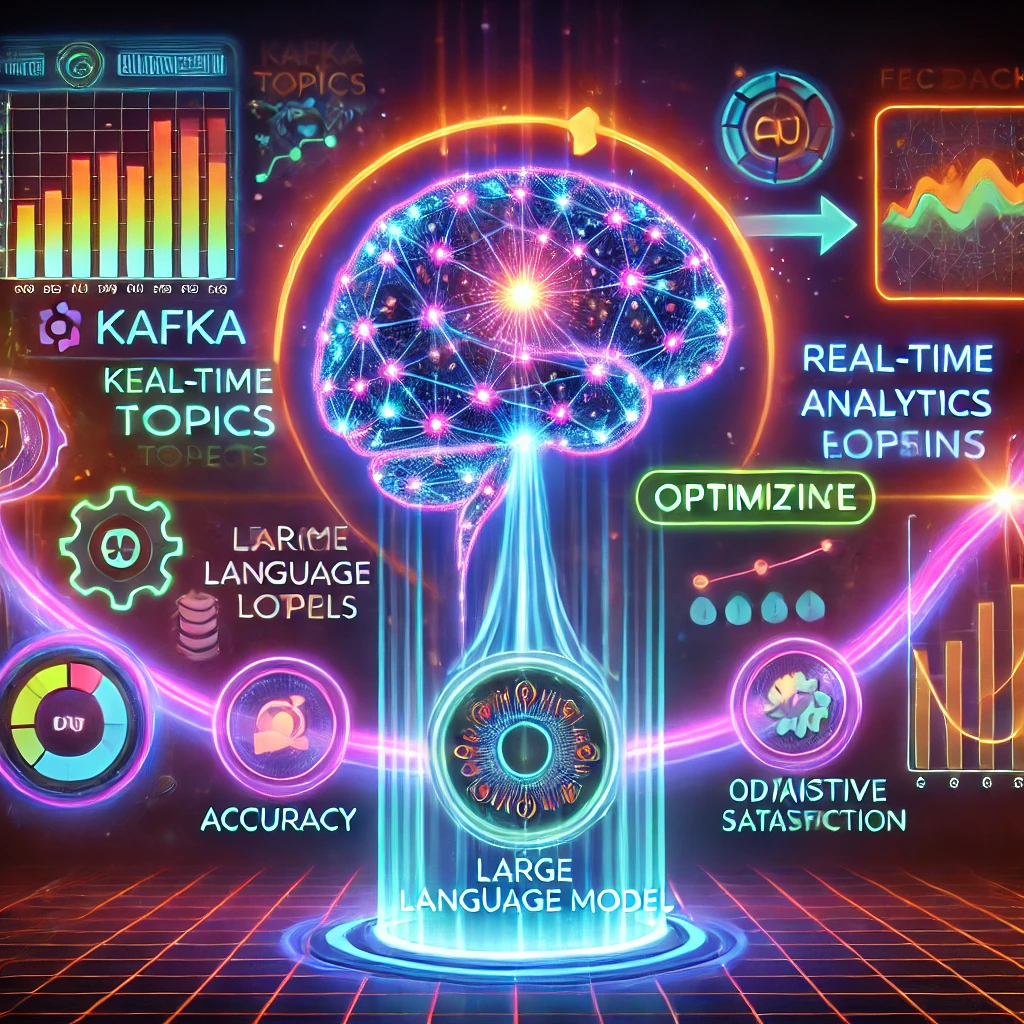
Large Language Models (LLMs) like GPT, BERT, and LLaMA are transforming industries by enabling intelligent automation, personalized interactions, and data-driven decision-making. However, fine-tuning these models for specific tasks or domains requires vast amounts of real-time feedback and continuous learning to ensure relevance and accuracy. This is where Kafka, a robust real-time event-streaming platform, plays a crucial role.
Kafka facilitates streaming feedback loops for dynamic fine-tuning of LLMs by enabling real-time data ingestion, processing, and seamless communication between users, applications, and model training systems. Let’s explore how Kafka-driven pipelines are shaping the future of LLM optimization.
Why Streaming Feedback Loops Matter for LLM Optimization
Traditional fine-tuning methods often rely on static datasets, which can lead to models becoming outdated or irrelevant over time. Streaming feedback loops address this challenge by enabling:
- Continuous Learning: Real-time updates keep models relevant as new data and use cases emerge.
- Adaptive Performance: Feedback allows models to improve dynamically, refining responses based on user behavior and interaction.
- Domain-Specific Optimization: Streaming pipelines allow for real-time incorporation of task-specific data, making LLMs more specialized.
How Kafka Powers Streaming Feedback Loops
Kafka’s distributed architecture and real-time data streaming capabilities make it an ideal backbone for LLM optimization. Here’s how it works:
- Ingesting User Feedback:
- Kafka collects real-time user interactions, such as chat logs, query responses, or click-through data.
- Example: A customer service chatbot powered by an LLM streams user conversations into Kafka topics for analysis.
- Processing Feedback:
- Kafka integrates with stream processing tools like Kafka Streams or Apache Flink to analyze feedback in real-time.
- Example: Analyzing sentiment from user feedback to identify where the model underperforms.
- Updating Training Data:
- Processed feedback is streamed into training data repositories, such as data lakes or feature stores, for model retraining.
- Example: A recommendation system for e-commerce adjusts its language model’s preferences based on product reviews streamed through Kafka.
- Triggering Fine-Tuning:
- Kafka events can trigger fine-tuning workflows, ensuring models are updated with the latest data.
- Example: A Kafka event triggers fine-tuning of a language model used in financial document summarization when new financial reports are ingested.
Use Cases for Kafka-Driven LLM Optimization
1. Customer Support Chatbots
- Scenario: A chatbot uses an LLM to handle customer queries.
- Kafka’s Role:
- Streams user interactions and feedback (e.g., unresolved queries or user ratings) into real-time analytics.
- Feedback is used to fine-tune the LLM to improve the accuracy of responses.
- Result: The chatbot evolves to handle complex queries more effectively, reducing escalation rates.
2. Real-Time Content Moderation
- Scenario: An LLM moderates content on a social media platform.
- Kafka’s Role:
- Streams flagged posts, user appeals, and moderation outcomes into a feedback loop.
- Feedback is processed to improve the model’s ability to identify harmful or inappropriate content.
- Result: Enhanced moderation accuracy with fewer false positives or negatives.
3. Personalized Learning Platforms
- Scenario: An LLM generates adaptive learning materials for students.
- Kafka’s Role:
- Streams user interactions, quiz results, and content preferences to fine-tune the LLM for personalized learning.
- Real-time feedback ensures the material aligns with individual learning styles.
- Result: A continuously improving educational experience tailored to student needs.
4. Financial Document Analysis
- Scenario: An LLM summarizes and analyzes financial reports for investment firms.
- Kafka’s Role:
- Streams new financial documents and user feedback on model summaries.
- Feedback is used to fine-tune the model’s understanding of domain-specific language and terminology.
- Result: Faster, more accurate insights for analysts and decision-makers.
Challenges and Solutions
- High Data Volume:
- Challenge: LLMs require vast amounts of feedback data, which can overwhelm pipelines.
- Solution: Use Kafka’s partitioning and scalability to handle high-throughput streams efficiently.
- Latency Sensitivity:
- Challenge: Real-time feedback processing must not delay model updates.
- Solution: Leverage lightweight stream processing tools and batch updates for non-critical feedback.
- Data Privacy:
- Challenge: Streaming sensitive user data for feedback loops can raise privacy concerns.
- Solution: Use Kafka’s encryption, access control, and data masking capabilities to secure sensitive information.
- Model Drift:
- Challenge: Continuous feedback may lead to overfitting or unintended biases.
- Solution: Incorporate observability tools to monitor model drift and ensure data quality in feedback streams.
Best Practices for Kafka-Driven LLM Optimization
- Implement Real-Time Metrics:
- Stream metrics like response time, accuracy, and user satisfaction to monitor model performance dynamically.
- Use Topic Partitioning:
- Partition Kafka topics based on use cases, such as user feedback, model performance, and retraining data, for better scalability.
- Integrate Observability Tools:
- Combine Kafka with observability platforms (e.g., Prometheus, Grafana) to track pipeline health and detect bottlenecks.
- Enable Feedback Prioritization:
- Use Kafka Streams to filter and prioritize high-value feedback, ensuring the most critical updates are addressed first.
- Combine Batch and Online Learning:
- Use Kafka for streaming immediate feedback and supplement with periodic batch updates to maintain model stability.
Future Directions
Kafka-driven feedback loops for LLMs will become increasingly sophisticated with advancements like:
- Federated Learning: Kafka can enable decentralized feedback collection for federated LLM fine-tuning across multiple devices.
- Multi-Modal Feedback: Kafka can stream text, audio, and video feedback for optimizing multi-modal LLMs.
- AI-Powered Observability: Machine learning models analyzing Kafka streams for predictive feedback optimization.
Kafka’s real-time streaming capabilities, combined with the dynamic nature of feedback loops, make it a cornerstone for optimizing large language models. By enabling continuous learning and adaptive performance, Kafka ensures that LLMs remain relevant, efficient, and powerful in a rapidly changing world. Organizations that adopt Kafka-driven feedback loops will unlock the full potential of LLMs, staying ahead in innovation and user satisfaction.
 AI Academy
Leave a comment