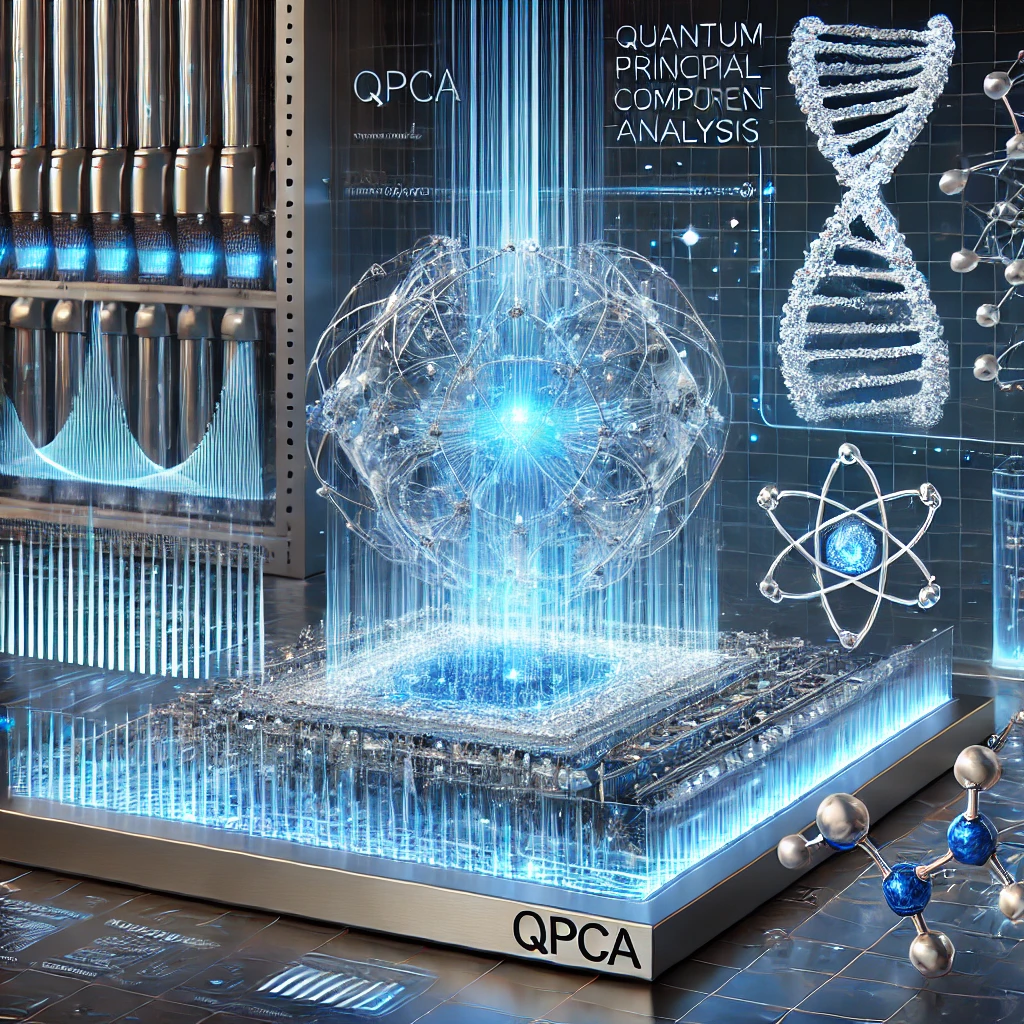
In today’s data-driven world, vast amounts of information are generated across industries, from healthcare and genomics to finance and marketing. Extracting meaningful insights from such immense datasets is critical but increasingly challenging for traditional computational methods. Quantum Principal Component Analysis (qPCA), a quantum algorithm, offers a transformative solution by enabling faster and more efficient data analysis.
The Challenge of Data Overload
As datasets grow larger and more complex, classical methods like Principal Component Analysis (PCA) struggle to keep up. PCA is a statistical technique used to reduce the dimensionality of data, simplifying it while retaining its essential patterns and features. While effective, PCA’s computational cost increases exponentially with the size of the dataset, creating bottlenecks in fields such as:
- Genomics: Analyzing genetic data to identify disease markers.
- Drug Discovery: Screening molecular structures for therapeutic potential.
- Finance: Modeling market trends and portfolio risks.
For industries where timely insights can save lives or millions of dollars, these delays are unacceptable. This is where quantum computing, specifically qPCA, steps in.
What is Quantum Principal Component Analysis?
qPCA is a quantum algorithm that significantly accelerates the process of dimensionality reduction. Unlike classical PCA, which processes one component at a time, qPCA leverages the quantum principles of superposition and entanglement to process multiple components simultaneously. This enables it to analyze datasets exponentially faster than its classical counterpart.
Key advantages of qPCA include:
- Speed: Quantum systems can extract principal components in logarithmic time relative to dataset size.
- Scalability: Ideal for high-dimensional datasets common in genomics, drug discovery, and AI.
- Efficiency: Reduces computational overhead while maintaining accuracy.
Applications of qPCA in Data-Intensive Fields
- Genomics
Genomics generates enormous datasets through sequencing technologies. qPCA can:- Identify disease-related genetic markers rapidly.
- Cluster genetic variations for population studies.
- Accelerate research into personalized medicine.
- Drug Discovery
Pharmaceutical research relies on sifting through millions of molecular structures to find viable drug candidates. qPCA can:- Analyze and classify molecular data quickly.
- Reduce time-to-market for new drugs by speeding up preclinical research.
- Optimize molecular docking simulations for targeted therapies.
- Finance and Risk Analysis
Financial institutions deal with complex datasets containing market trends, economic indicators, and customer behaviors. qPCA can:- Model market correlations and volatility with greater precision.
- Optimize portfolio diversification strategies.
- Detect anomalies in trading patterns for fraud prevention.
- Artificial Intelligence and Machine Learning
AI systems require vast datasets for training, and reducing these datasets without losing critical information is essential. qPCA:- Speeds up preprocessing for large AI models.
- Improves feature selection for better model performance.
- Enables real-time data analysis for adaptive systems.
Advantages of Accelerated Data Analysis
The ability to process data at quantum speeds has profound implications:
- Increased Productivity: Researchers and analysts can focus on interpretation rather than data wrangling.
- Better Insights: Faster computations mean more time for exploratory analysis and hypothesis testing.
- Cost Savings: Reduced computational overhead leads to lower operational expenses.
Challenges to Implementation
Despite its promise, qPCA faces hurdles:
- Hardware Limitations: Current quantum computers are still in their early stages, with limited qubits and error rates.
- Integration Complexity: Adopting qPCA requires integrating quantum hardware with existing classical systems.
- Expertise Gap: The field of quantum computing is still niche, with limited resources and expertise available.
The Future of Quantum Data Analysis
As quantum technology matures, qPCA and other quantum algorithms will become more accessible and robust. In the near future, organizations will use quantum systems not only to analyze data but also to generate predictions, optimize operations, and innovate faster than ever before.
Early adopters of qPCA stand to gain a competitive edge, particularly in industries where data-driven decisions are critical. The ability to extract insights from vast datasets in record time will redefine benchmarks for efficiency and accuracy.
 AI Academy
Leave a comment