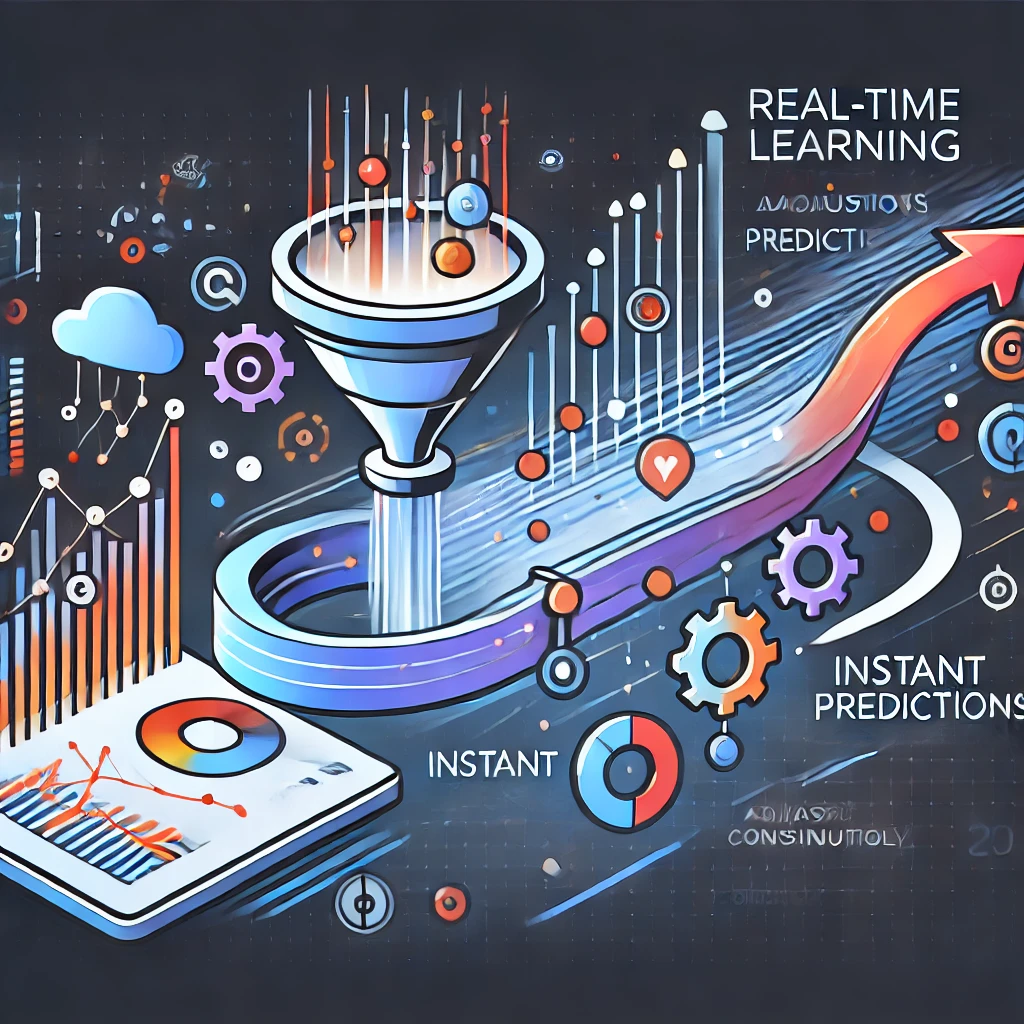
Real-time learning is closely related to online learning but places more emphasis on generating predictions or decisions instantly as data is processed. It ensures that the model not only learns continuously but also makes immediate adjustments to its predictions, thus allowing the system to respond to changes without delay.
How It Happens:
- Data streams into the system, and the model makes instantaneous predictions or decisions.
- Models typically use lightweight, low-latency algorithms to ensure predictions are made in real time.
- Real-time learning is often deployed in environments where decisions must be made within milliseconds or seconds.
Real-World Applications:
- Autonomous Vehicles: Self-driving cars rely on real-time learning to adapt to changing traffic conditions, road signs, and obstacles.
- Financial Trading: Algorithmic trading systems use real-time learning to analyze market trends and execute trades automatically.
- Fraud Detection: Real-time learning systems can detect fraudulent activity by analyzing transaction patterns and identifying anomalies.
- Healthcare Monitoring: Wearable devices and medical equipment use real-time learning to monitor patient health and provide timely alerts.
- Recommendation Systems: Real-time learning can personalize recommendations based on user behavior and preferences.
Here is the process in more details:
- Data Ingestion: Data is continuously streamed into the system, often from sensors, IoT devices, or other real-time sources.
- Feature Extraction: Relevant features are extracted from the raw data to represent the information in a suitable format for the model.
- Model Update: The model is updated incrementally based on the new data, using techniques like online gradient descent or stochastic gradient descent.
- Prediction or Decision: The updated model is used to make predictions or decisions in real-time.
- Feedback Loop: The system may incorporate feedback mechanisms to further refine the model’s performance.
Key Algorithms for Real-Time Learning
- Hoeffding Trees:
- How it works: Hoeffding Trees are decision trees that are built incrementally, one node at a time. They use a statistical test (Hoeffding bound) to determine when to split a node.
- Advantages: Efficient, low-latency, and suitable for high-speed data streams.
- Use Cases: Real-time anomaly detection, network intrusion detection, and recommendation systems.
- Exponential Moving Average (EMA):
- How it works: EMA assigns exponentially decreasing weights to past data points, giving more importance to recent observations.
- Advantages: Simple, computationally efficient, and suitable for time-series data.
- Use Cases: Stock price prediction, trend analysis, and signal processing.
- Kalman Filters:
- How it works: Kalman Filters are used to estimate the state of a system from a series of noisy measurements.
- Advantages: Efficient, accurate, and suitable for tracking and predicting the state of dynamic systems.
- Use Cases: Autonomous vehicle navigation, sensor fusion, and GPS signal processing.
Challenges and Considerations
- Data Quality: Ensuring the quality and reliability of real-time data is crucial for effective learning.
- Model Drift: As data distributions change over time, models may need to be updated or retrained to maintain accuracy.
- Computational Efficiency: Real-time learning algorithms must be computationally efficient to handle high-volume data streams.
- Ethical Considerations: Real-time learning systems can raise ethical concerns, such as privacy and bias.
By addressing these challenges and leveraging the power of real-time learning algorithms, organizations can gain a competitive edge and unlock new opportunities in a data-driven world.
 AI Academy
Leave a comment