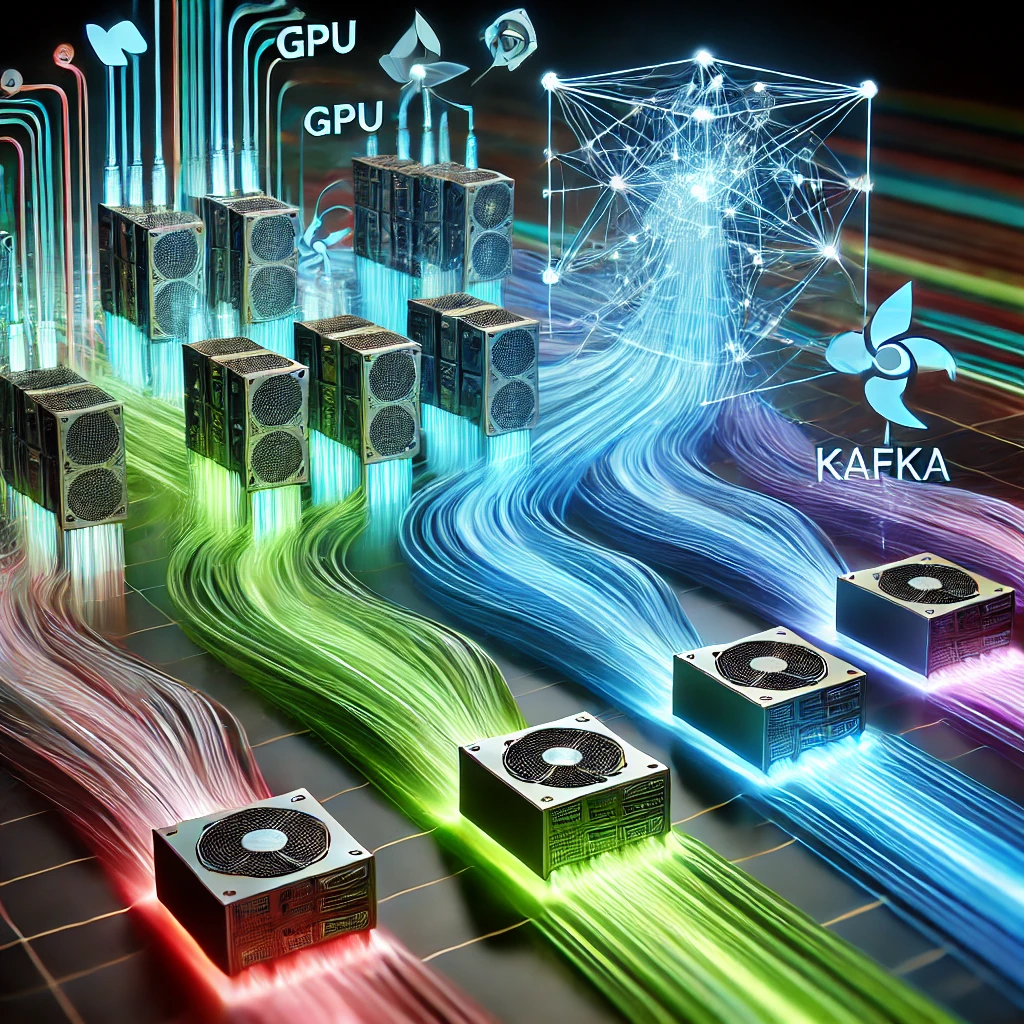
As machine learning models grow in complexity and size, optimizing tensor programs for efficient execution across diverse hardware architectures becomes essential. Tensor operations, such as matrix multiplications, convolutions, and reductions, demand high performance from the underlying hardware, which includes GPUs, TPUs, and other accelerators. While frameworks like Pallas and Mosaic have made it easier to write custom kernels for these operations, achieving peak performance across different platforms requires continuous optimization. This is where Kafka can play a critical role by providing real-time data streaming of performance metrics and execution data, enabling machine learning models to optimize tensor programs dynamically.
In this article, I explore how Kafka can be leveraged to stream real-time performance data from tensor programs, how this data is used to drive machine learning-based optimizations, and the advantages of implementing a real-time feedback loop in deep learning workloads.
The Challenge of Tensor Program Optimization
Tensor programs perform operations on multi-dimensional arrays of data, which are central to most deep learning models. However, optimizing these programs to fully utilize the hardware’s computational power is non-trivial. Some of the challenges include:
- Hardware Heterogeneity: Tensor programs need to run efficiently across different hardware, each with its own architecture and performance characteristics.
- Memory Bottlenecks: Memory access patterns, data movement between different levels of memory, and cache utilization significantly impact the speed of tensor operations.
- Parallelism: Maximizing parallel execution on multi-core architectures requires tuning kernel configurations, which often involves trial and error.
Addressing these challenges requires continuous monitoring of tensor program performance and using this data to adapt execution strategies dynamically.
Kafka’s Role in Tensor Program Optimization
Kafka is a distributed streaming platform that can process high volumes of data in real time. By leveraging Kafka to collect and stream execution metrics from tensor programs, developers can create a feedback loop where performance data is continuously analyzed, and machine learning models optimize the programs accordingly.
Key Benefits of Using Kafka for Tensor Optimization:
- Real-Time Data Collection: Kafka can stream metrics such as memory usage, execution times, data throughput, and GPU/TPU utilization from tensor programs in real-time.
- Scalability: As tensor programs often run on distributed hardware environments, Kafka’s ability to handle high-throughput, low-latency data pipelines makes it ideal for scaling tensor operations across multiple devices.
- Continuous Feedback Loop: By streaming performance data to machine learning models, Kafka enables dynamic adjustments to kernel configurations and execution strategies based on real-time insights.
- Fault Tolerance and Reliability: Kafka’s distributed nature ensures that even if parts of the hardware infrastructure fail, the data pipeline remains operational, allowing for uninterrupted optimization of tensor programs.
How Kafka Streams Performance Metrics
The integration of Kafka into tensor program optimization typically involves setting up data pipelines that collect relevant metrics from the running tensor programs. These metrics are then streamed to machine learning models that can make real-time decisions on how to adjust kernel parameters, optimize memory access, or change execution strategies.
Components of Kafka Data Streaming for Tensor Programs:
- Producers: Tensor programs act as producers that emit performance metrics and execution data at regular intervals or based on specific triggers (e.g., kernel execution completion).
- Kafka Brokers: These brokers distribute the streaming data to the appropriate consumers, ensuring low-latency and high-throughput data delivery.
- Consumers: Machine learning models, monitoring dashboards, or other analytical tools act as consumers that process the incoming data. These consumers can reside on the same hardware as the tensor programs or on remote systems, enabling flexible deployment architectures.
- Real-Time Processing Engines: Kafka streams or other real-time processing engines like Apache Flink or Apache Spark can be used to preprocess, aggregate, and analyze the performance metrics before feeding them into the machine learning models.
Real-World Application: Optimizing a CNN on Distributed GPUs
To illustrate Kafka’s role in real-time tensor program optimization, consider a deep learning model like a Convolutional Neural Network (CNN) being trained on distributed GPUs. During each training iteration, Kafka can stream metrics such as GPU utilization, memory access times, and tensor operation latencies from each node in the distributed system. These metrics are processed in real-time and used to dynamically adjust the kernel launch configurations and optimize data movement across the GPUs.
Example Workflow:
- Data Collection: Each GPU node streams execution metrics, such as kernel execution times and memory bandwidth usage, to Kafka brokers.
- Data Processing: Kafka Streams processes the data to detect patterns like memory bottlenecks or under-utilization of GPU cores.
- ML-Based Optimization: The processed data is sent to a machine learning model trained to identify optimal configurations for tensor operations. For instance, it may suggest increasing the grid size for a kernel launch or adjusting the memory tiling strategy.
- Dynamic Reconfiguration: Based on the model’s output, the tensor program dynamically adjusts its execution strategy for the next iteration, ensuring better hardware utilization and faster execution.
Advantages of Real-Time Feedback in Tensor Program Optimization
By integrating Kafka into the tensor program optimization process, several key advantages can be realized:
- Adaptive Optimization: Machine learning models can continuously learn from new data, allowing them to adapt to changing hardware conditions or model requirements. This is particularly useful in distributed environments where hardware performance can vary.
- Reduced Manual Tuning: Optimizing tensor programs traditionally requires manual tuning of parameters, which is time-consuming and often suboptimal. With Kafka, the optimization process is automated, reducing the need for human intervention.
- Improved Performance and Efficiency: Real-time feedback ensures that tensor programs always run with near-optimal configurations, maximizing the hardware’s computational power and minimizing resource waste.
- Scalability Across Platforms: Kafka enables the optimization process to scale effortlessly across distributed environments, whether the tensor programs are running on local hardware, cloud GPUs, or edge devices.
As deep learning models continue to scale, the importance of optimizing tensor programs for efficient execution cannot be overstated. Kafka offers a robust solution for real-time data streaming, providing the continuous feedback loop necessary to optimize these programs dynamically. By leveraging Kafka to stream performance metrics and execution data, machine learning models can automatically tune kernel configurations, adjust memory access patterns, and enhance parallelism—leading to more efficient deep learning workloads.
Integrating Kafka into tensor program optimization pipelines is a promising approach that not only automates the optimization process but also ensures that deep learning models can scale seamlessly across a wide variety of hardware architectures.
 AI Academy
Leave a comment