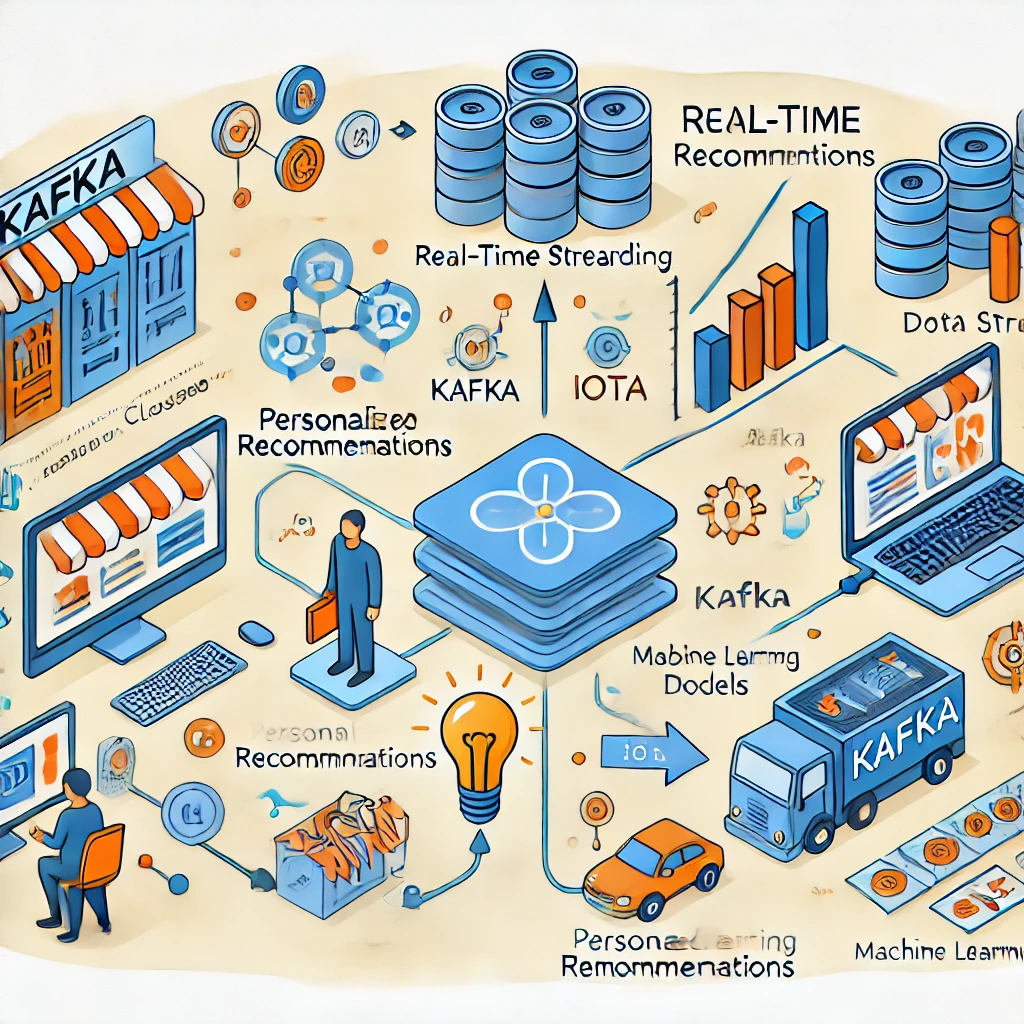
Delivering personalized experiences is paramount for businesses to thrive. By understanding and responding to customer behavior in real-time, organizations can significantly enhance customer satisfaction, increase engagement, and drive revenue. This article explores how real-time streaming platforms like Kafka can be used for customer behavior analysis and personalized recommendations.
The Power of Real-Time Data
Traditional batch-based data processing methods often fall short in capturing the dynamic nature of customer behavior. Real-time streaming platforms like Kafka offer a solution by enabling continuous ingestion and processing of data as it’s generated. This allows businesses to react swiftly to customer interactions and deliver timely, relevant recommendations.
Key Components of a Real-Time Recommendation System
Data Ingestion:
- Capture a wide range of customer data, including website clicks, purchases, search queries, and social media interactions.
- Utilize Kafka’s ability to handle high throughput and low latency to ingest data in real-time.
Data Enrichment:
- Enrich customer data with additional information from external sources such as demographics, purchase history, and product catalogs.
- Use Kafka Streams or other stream processing engines to perform data transformations and enrichments.
Feature Engineering:
- Extract meaningful features from the enriched data to feed into machine learning models.
- Consider features like user segments, product categories, time-based patterns, and contextual information.
Model Training and Deployment:
- Develop machine learning models (e.g., collaborative filtering, content-based, hybrid) to generate recommendations.
- Continuously train and retrain models using updated data from Kafka.
- Deploy models as microservices for real-time inference.
Recommendation Delivery:
- Integrate recommendation models with front-end applications to display personalized recommendations.
- Explore A/B testing and experimentation to optimize recommendation strategies.
Kafka’s Role in Real-Time Recommendations
Kafka’s distributed architecture, fault tolerance, and high throughput make it an ideal platform for real-time recommendation systems. Key benefits include:
- Scalability: Handle increasing data volumes and user traffic.
- Real-time processing: Process data as it arrives, enabling immediate response.
- Fault tolerance: Make sure data durability and system availability.
- Integration: Connect to various data sources and systems.
Challenges and Considerations
- Data Quality: Make sure data accuracy, completeness, and consistency for reliable recommendations.
- Privacy and Security: Protect customer data and follow regulations.
- Model Complexity: Balance model accuracy with performance and explainability.
- Cold Start Problem: Give recommendations for new users with limited data.
By using real-time streaming platforms like Kafka and advanced machine learning techniques, businesses can create highly personalized and engaging customer experiences. This approach allows organizations to stay ahead of the competition and build lasting customer relationships.
 AI Academy
Leave a comment