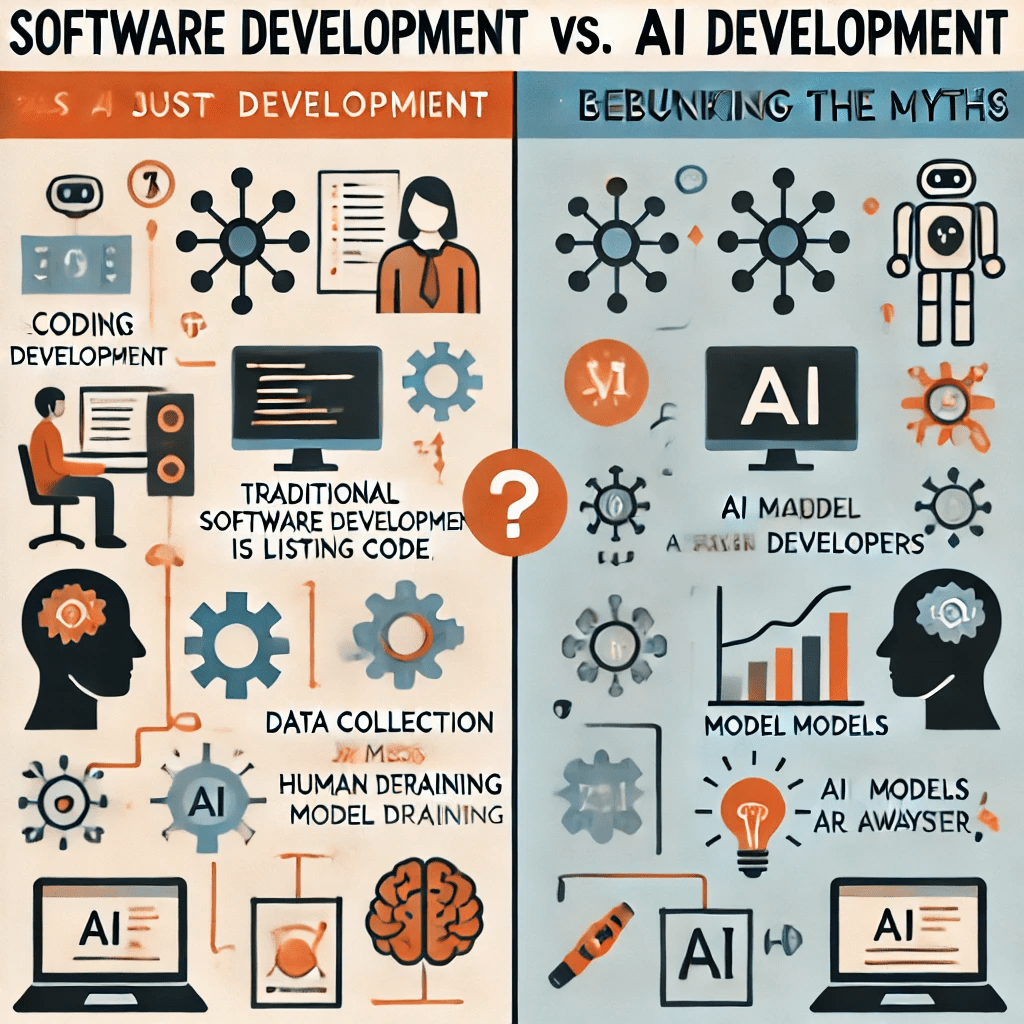
Software development and AI development are often seen as interchangeable fields, given their reliance on programming and technology. However, they are distinct disciplines with unique challenges, methodologies, and outcomes. This article aims to debunk common myths surrounding software and AI development, providing a clearer understanding of each field.
Myth 1: AI Development is Just a Subset of Software Development
Reality:
While AI development involves software development principles, it encompasses a broader range of activities focused on creating intelligent systems. Traditional software development typically follows a linear process: requirements gathering, design, coding, testing, and maintenance. In contrast, AI development is iterative and experimental, requiring continuous model training, validation, and refinement.
Key Differences:
- Objective: Traditional software aims to perform predefined tasks, whereas AI aims to simulate human intelligence and learn from data.
- Development Cycle: Software development follows a more predictable cycle, while AI development is iterative and data-driven.
- Testing: Software testing verifies functionality against requirements, while AI testing involves validating model accuracy and performance.
Myth 2: AI Development is Just About Writing Code
Reality:
AI development goes beyond coding. It involves data collection and preprocessing, feature engineering, model selection, training, hyperparameter tuning, and deployment. The success of an AI project heavily depends on the quality of the data and the appropriateness of the chosen algorithms.
Key Activities:
- Data Handling: Collecting, cleaning, and preprocessing large datasets.
- Model Training: Experimenting with different algorithms and architectures.
- Validation: Evaluating model performance using various metrics.
- Deployment: Integrating the AI model into production environments, often requiring specialized infrastructures
Myth 3: AI Can Replace Human Developers
Reality:
AI can automate certain tasks and assist developers, but it cannot replace human creativity, problem-solving, and domain expertise. AI tools can generate code snippets, identify bugs, and suggest improvements, but they lack the nuanced understanding of complex requirements and the ability to innovate like human developers.
Human vs. AI:
- Creativity: Human developers excel at creative problem-solving and designing novel solutions.
- Context Understanding: Humans can grasp the broader context and implications of their work.
- Adaptability: Human developers can adapt to changing requirements and unforeseen challenges.
Myth 4: AI Development is Too Complex for Most Developers
Reality:
While AI development has a steep learning curve, it is becoming more accessible thanks to open-source libraries, pre-trained models, and user-friendly development frameworks. Developers with a solid foundation in programming and a willingness to learn can transition into AI development.
Learning Path:
- Foundation: Strong understanding of programming (Python, R), mathematics (linear algebra, calculus), and statistics.
- Tools: Familiarity with AI frameworks like TensorFlow, PyTorch, and Scikit-learn.
- Practice: Hands-on experience through projects, competitions (e.g., Kaggle), and collaboration with experienced AI practitioners.
Myth 5: AI Models are Always Better Than Traditional Software Solutions
Reality:
AI models excel in tasks involving pattern recognition, prediction, and automation of complex processes, but they are not always the best solution. Traditional software solutions can be more efficient, reliable, and easier to implement for straightforward tasks with well-defined rules.
Choosing the Right Approach:
- Task Complexity: Use AI for tasks that involve learning from data, such as image recognition, natural language processing, and predictive analytics.
- Resource Availability: Consider the availability of data, computational resources, and expertise.
- Requirements: Evaluate whether the flexibility and adaptability of AI outweigh the simplicity and determinism of traditional software.
Myth 6: Anyone Can Develop AI
Reality: While AI development is becoming more accessible, it requires specialized knowledge and skills. Understanding machine learning algorithms, data science principles, and software engineering practices is essential. A strong foundation in computer science and mathematics is often beneficial.
Myth 7: AI Development is Always Expensive
Reality: The cost of AI development varies depending on project complexity, data requirements, and desired performance. Open-source libraries and tools can significantly reduce costs, but expertise in utilizing them is necessary. Cloud computing platforms offer flexible pricing options for infrastructure and training resources.
Understanding the differences between software development and AI development is crucial for making informed decisions and setting realistic expectations. While they share some common ground, each field has its unique challenges and methodologies. Debunking these myths helps clarify what each discipline entails and how they can complement each other to drive innovation and solve complex problems.
 AI Academy
Leave a comment