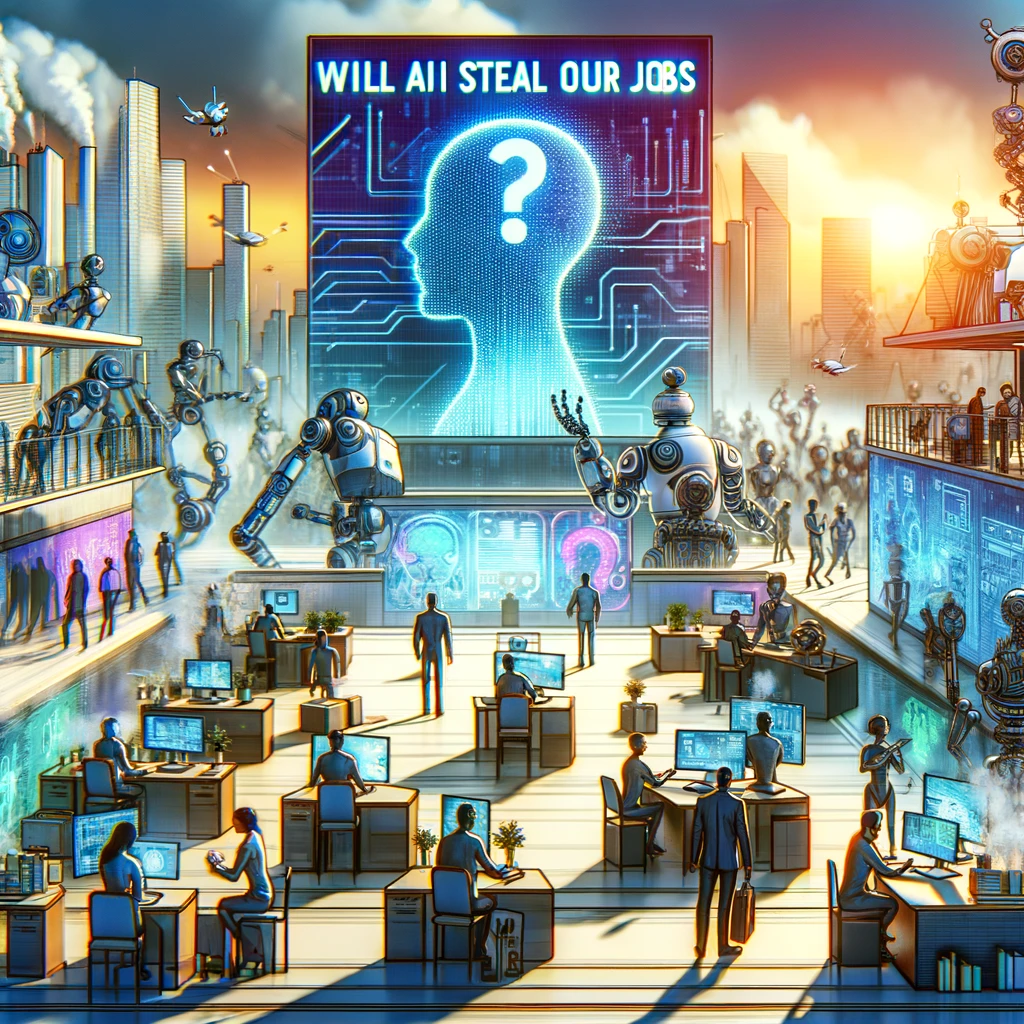
The question of whether Artificial Intelligence (AI) will replace our jobs has sparked discussions and also tapping into our deepest fears of losing jobs. To grasp what the future holds, let’s journey back to a moment in history – the dawn of the computer era – and draw parallels to today’s AI revolution.
The Computer Era: A Lesson from History
When computers first entered the workplace, there was widespread panic. Many feared machines would take over jobs, leaving masses unemployed. However, as history unfolded, computers didn’t herald an end to employment. Instead, they transformed it. New jobs were born, industries evolved, and the workforce adapted, learning to use the power of computers to achieve more than ever before.
Let’s rewind to the clackety-clack of typewriters. Back then, stenographers and clerks worried that the invention of the computer would make them obsolete. Fast forward, and while typewriters are museum pieces, those worried workers found new niches. Computers created a whole new wave of jobs: programmers, web developers, data analysts – fields that didn’t even exist before.
AI is poised to be the next big transformer, not a terminator. Here’s why:
- AI excels at automation: Repetitive tasks like data entry, scheduling, or basic customer service are prime targets for AI. This frees up human workers to focus on more complex tasks that require creativity, empathy, and critical thinking. Imagine doctors focusing on diagnosing patients instead of filling out endless paperwork.
- AI is a tool, not a replacement: Just like a hammer doesn’t replace a carpenter, AI won’t replace workers. It will be a powerful tool that can augment human capabilities. Think of an AI-powered design software that helps architects brainstorm ideas or a legal research AI that assists lawyers in building stronger cases.
- New jobs will emerge: As AI automates tasks, new opportunities will arise. We’ll need people to design, develop, maintain, and oversee these AI systems. Jobs in AI ethics, data security, and human-AI collaboration will be crucial.
However, history doesn’t always repeat itself perfectly. Here’s where we need to be cautious:
- The shift won’t be equal: While some jobs will be created, others will undoubtedly be lost. We need to ensure people have the skills and training to adapt to the changing job market.
- The AI gap: The benefits of AI shouldn’t be concentrated in the hands of a few. We need to bridge the digital divide and ensure everyone has access to AI education and training.
- Ethical considerations: As AI becomes more sophisticated, ethical questions will arise. We need to be mindful of bias in AI algorithms and ensure they are used responsibly.
Moreover, AI is expected to enhance many jobs by taking over tedious tasks, allowing humans to focus on areas requiring creativity, emotional intelligence, and strategic thinking. For instance, in medicine, AI can handle diagnostic processes, enabling doctors to spend more time on patient care and complex medical decision
Certain qualities make humans irreplaceable. Creativity, empathy, emotional intelligence, and the ability to navigate complex social interactions are just a few areas where humans excel. Jobs that rely heavily on these skills, such as in therapy, education, and creative industries, are likely to see AI as a tool rather than a replacement.
The key to navigating the AI revolution is adaptability. Much like the workforce of the past learned to work with computers, today’s workforce will need to adapt to AI, embracing lifelong learning and acquiring new skills. Governments, educational institutions, and corporations play crucial roles in facilitating this transition, ensuring that workers are equipped to thrive in an AI-enhanced future.
So, will AI replace our jobs? Not entirely. But it will change them dramatically. The key is to embrace AI as a partner, not a competitor. By focusing on education, upskilling, and ethical development, we can ensure that the future of work is one of human-AI collaboration, not human-AI competition. After all, the best creations often come from the combined power of human ingenuity and technological innovation.
 AI Academy
Leave a comment