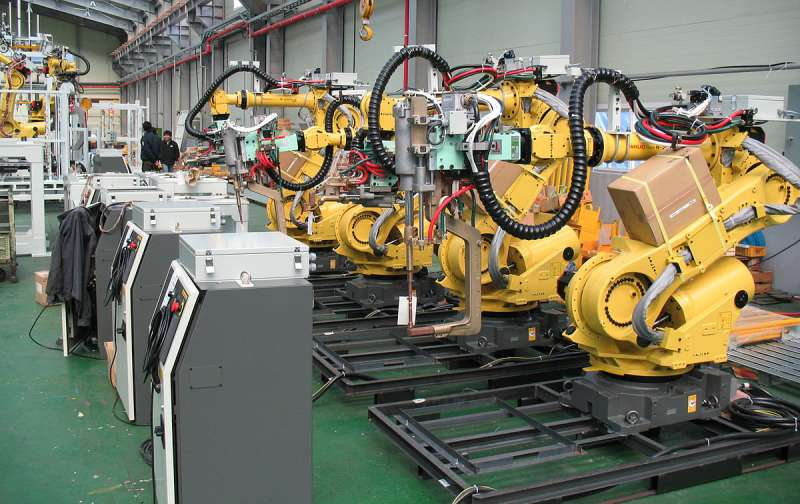
Photo credits: https://phys.org/news/2018-02-robots-workers-world.html
The rise of artificial intelligence (AI) is no longer science fiction; it’s reshaping our present and painting a dynamic picture of the future of work. While anxieties about robots stealing jobs abound, the reality is far more nuanced. AI isn’t here to replace us, but to reimagine the colloboration between human and machine. Let’s delve into how AI is transforming the job market and what skills will be the coveted currency in this evolving landscape.
The Current State of AI in the Job Market:
AI’s impact on the job market is already evident across various sectors. From automating routine tasks in manufacturing to enhancing precision in healthcare, AI applications are diverse. In customer service, AI chatbots are handling basic inquiries, allowing human employees to focus on more complex issues. In finance, AI algorithms are used for risk assessment and fraud detection.
The ability of AI to process and analyze vast amounts of data more efficiently than humans is also leading to significant advancements in fields such as drug development, environmental conservation, and urban planning.
The Changing Nature of Jobs
As AI takes over more routine and repetitive tasks, the nature of jobs is evolving. There is a growing demand for roles that require human creativity, critical thinking, and emotional intelligence – skills that AI has yet to master. For example, while AI can diagnose a disease, healthcare professionals are needed for empathetic patient care. Similarly, in creative industries, AI can assist in the creative process, but original ideas and emotional depth remain a human forte. From crunching numbers in accounting to scanning legal documents, AI is bring integrated into these roles with remarkable efficiency. This automation will undoubtedly displace some jobs, particularly in sectors like manufacturing and data entry.
But fear not, the human touch remains irreplaceable. Tasks requiring creativity, critical thinking, and emotional intelligence will stay firmly in our domain. Imagine a doctor diagnosing a patient, not just with the cold logic of algorithms, but with empathy and nuanced understanding. That’s where the human magic lies.
The Human Advantage: Stepping Up Our Game
So, what skills will set us apart in this AI-infused future? Here’s the good news: the skills that make us uniquely human are precisely the ones in high demand.
- Creativity and Innovation: As AI handles the mundane, our ability to think outside the box and generate novel ideas will be paramount. From designing AI-powered solutions to crafting compelling marketing campaigns, creativity will be the fuel that propels progress.
- Critical Thinking and Problem-Solving: AI excels at crunching data and following patterns, but it lacks the human capacity for critical thinking and complex problem-solving. The ability to analyze situations, identify root causes, and devise creative solutions will be invaluable in navigating the ever-changing work landscape.
- Emotional Intelligence and Communication: The human touch remains crucial in building relationships, fostering collaboration, and navigating the emotional nuances of any workplace. Empathy, effective communication, and strong interpersonal skills will be the secret sauce that sets us apart from the machines.
- Adaptability and Lifelong Learning: The future of work demands agility. The ability to learn new skills, adapt to changing technologies, and embrace continuous learning will be key to thriving in a dynamic environment.
Skills for Future:
To stay relevant in an AI-driven job market, individuals will need to focus on developing certain skills:
- Technical Proficiency: Understanding the basics of AI and machine learning will become essential, even for non-technical roles.
- Problem-Solving and Critical Thinking: The ability to approach problems creatively and critically is vital.
- Adaptability and Continuous Learning: With the rapid evolution of technology, the willingness to learn and adapt is crucial.
- Emotional Intelligence: Skills like empathy, communication, and understanding human emotions will become more valuable as they are irreplaceable by AI.
- Collaboration: Working effectively with both humans and AI systems will be a key skill.
The Role of Eductaion and Training:
Education systems must evolve to prepare the future workforce for an AI-centric world. This includes integrating AI and technology education at all levels and promoting lifelong learning and upskilling opportunities. Partnerships between educational institutions and industries can ensure that the curriculum remains relevant to the changing job market.
The Future: Humans and AI in Harmony
The future of work won’t be a solo act for humans or machines. It’s a symphony, where AI augments our capabilities and frees us to focus on what we do best: creativity, innovation, and uniquely human skills. By embracing AI as a collaborator, not a competitor, we can unlock a future filled with exciting possibilities.
Imagine doctors using AI to diagnose diseases with pinpoint accuracy, while they focus on providing personalized care and emotional support to patients. Or envision engineers working alongside AI to design sustainable cities, leveraging the machines’ computational power to optimize solutions while applying their own creativity and empathy to shape livable spaces.
The future of work is not about humans versus machines; it’s about humans and machines working together in harmony. By honing our uniquely human skills and collaborating effectively with AI, we can orchestrate a future that is not only productive but also fulfilling, meaningful, and distinctly human.
 AI Academy
Leave a comment