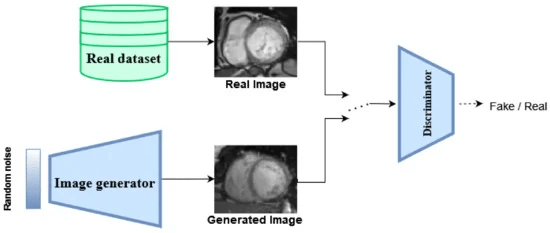
Photo Credits:https://www.mdpi.com/2313-433X/9/3/69
Generative adversarial networks (GANs) are a type of machine learning model that can be used to generate synthetic data. GANs work by pitting two neural networks against each other: a generator and a discriminator. The generator tries to create synthetic data that is indistinguishable from real data, while the discriminator tries to distinguish between real and synthetic data.
GANs have the potential to revolutionize the healthcare industry. By generating synthetic medical images, GANs can help to reduce the need for expensive and time-consuming clinical trials. GANs can also be used to assist in disease diagnosis and drug discovery.
Generating synthetic medical images
One of the most promising applications of GANs in healthcare is the generation of synthetic medical images. Synthetic medical images are artificially generated images that are indistinguishable from real medical images. This makes them ideal for use in clinical trials, as they can be used to train and test machine learning models without the need for real patient data.
GANs have been used to generate synthetic medical images of a variety of different organs and tissues, including the brain, heart, and lungs. For example, researchers at Stanford University have used GANs to generate synthetic CT scans of the brain. These synthetic CT scans were then used to train a machine learning model to detect brain tumors. The model was able to achieve an accuracy of 99% on the synthetic CT scans, and it also performed well on real CT scans.
Assisting in disease diagnosis
GANs can also be used to assist in disease diagnosis and early detection. They can be used to generate synthetic data representing various stages and manifestations of diseases, helping healthcare professionals better understand and recognize pathological conditions. By training deep learning models on synthetic data, we can improve the accuracy of diagnostic tools, thereby facilitating earlier detection and more effective treatment.
Moreover, GANs can be employed to create augmented reality representations of medical images. Surgeons, for instance, can utilize this technology to overlay synthetic 3D models onto a patient’s anatomy, enhancing precision during surgical procedures
For example, researchers at the University of California, San Francisco have used GANs to develop a new method for diagnosing Alzheimer’s disease. The method uses GANs to generate synthetic MRI images of the brain. These synthetic MRI images are then used to train a machine learning model to identify the early signs of Alzheimer’s disease.
The machine learning model was able to achieve an accuracy of 95% on the synthetic MRI images, and it also performed well on real MRI images. This suggests that GANs could be used to develop new and more accurate methods for diagnosing Alzheimer’s disease and other diseases.
Accelerating Drug discovery
GANs can also be used to accelerate drug discovery. Drug discovery is a time-consuming and costly process, often hindered by the need for extensive datasets of molecular structures and biological interactions. GANs are coming to the rescue by generating synthetic molecular structures and simulating biochemical interactions. This accelerates the drug discovery process by enabling researchers to explore a broader range of compounds and their potential effects. It’s not only about saving time and resources but also about increasing the likelihood of discovering groundbreaking medications more quickly.
For example, researchers at the University of Toronto have used GANs to develop a new method for identifying potential drug targets. The method uses GANs to generate synthetic molecular structures of proteins. These synthetic molecular structures are then used to train a machine learning model to identify proteins that are likely to be involved in disease.
The machine learning model was able to identify potential drug targets with an accuracy of 90%. This suggests that GANs could be used to accelerate drug discovery by helping researchers to identify new and promising drug targets.
Ethical Considerations and Challenges
While the potential of GANs in healthcare is astounding, it’s essential to address ethical considerations, including patient data privacy and the responsible use of synthetic data. Moreover, the challenge of ensuring the generated data is truly representative of real-world scenarios is an ongoing concern that requires rigorous validation and scrutiny.
GANs are a powerful machine learning tool with the potential to revolutionize the healthcare industry. GANs are already being used to generate synthetic medical images, assist in disease diagnosis, and accelerate drug discovery. In the future, GANs are likely to be used in even more ways to improve healthcare delivery and outcomes.
 AI Academy
Leave a comment