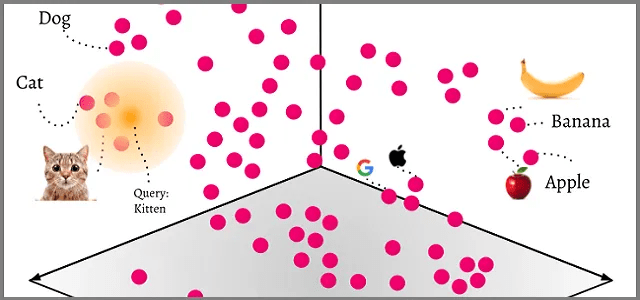
Photo Credits: https://blog.devgenius.io/an-evaluation-of-vector-database-systems-features-and-use-cases-9a90b05eb51f
Data management and retrieval play a pivotal role in building robust models. Amidst various tools and techniques, vector databases have emerged as a game-changer, revolutionizing the way we store, search, and analyze high-dimensional vectors. In this article, we will explore the concept of vector databases, showcase their real-world applications, and discuss scenarios where they thrive, as well as situations where alternative approaches are more suitable.
Understanding Vector Databases:
Vector databases, also known as similarity search databases, are purpose-built to efficiently store, index, and query high-dimensional vectors. They leverage sophisticated algorithms and data structures, enabling rapid search and retrieval of vectors based on their similarities or distances within a multi-dimensional space.
When to Use Vector Databases:
Recommendation Systems:
- Example: In an e-commerce platform, a vector database can store customer preferences as vectors and efficiently match them with similar products for personalized recommendations. This approach enhances user satisfaction and drives sales.
Image and Video Retrieval:
- Example: Social media platforms utilize vector databases to power image search functionalities. By extracting feature vectors from images, the system can identify similar images or recommend visually related content, enhancing user engagement.
Natural Language Processing:
- Example: Text similarity search is a prime use case for vector databases. By representing text documents or word embeddings as vectors, these databases enable semantic searches, document clustering, or even chatbot-based applications where responses are based on vector similarity.
Anomaly Detection:
- Example: Vector databases are instrumental in anomaly detection scenarios. By maintaining a vector representation of normal behavior, any deviations from the reference vectors can be quickly identified, alerting system administrators to potential security breaches or system failures.
When Not to Use Vector Databases:
Structured Data:
- Example: Traditional relational databases are better suited for structured data with clearly defined schemas and relationships. If your data fits into a structured format, opting for a vector database may introduce unnecessary complexity.
Exact Matching:
- Example: If your use case demands precise matches, where elements must be identical, vector databases may not be the most efficient choice. Hash-based data structures or traditional databases can offer better performance in such scenarios.
Low-Dimensional Data:
- Example: Vector databases shine in high-dimensional spaces, where data has numerous dimensions. However, for low-dimensional datasets, the overhead of using a vector database might outweigh the benefits. Simpler indexing techniques or traditional databases may suffice.
Vector databases have ushered in a new era of data management for machine learning applications. They excel in recommendation systems, image and video retrieval, natural language processing, and anomaly detection. By leveraging vector similarities, these databases provide enhanced search capabilities and enable personalized experiences. However, it’s crucial to consider the specific characteristics of your data and the requirements of your application. Structured data, exact matching scenarios, and low-dimensional datasets may call for alternative approaches. A comprehensive understanding of the strengths and limitations of vector databases empowers machine learning practitioners to make informed decisions and leverage the right tools to maximize the potential of their projects.
 AI Academy
Leave a comment